When the Earth Measures Itself: A Journey Through the Thin Air of Ladakh
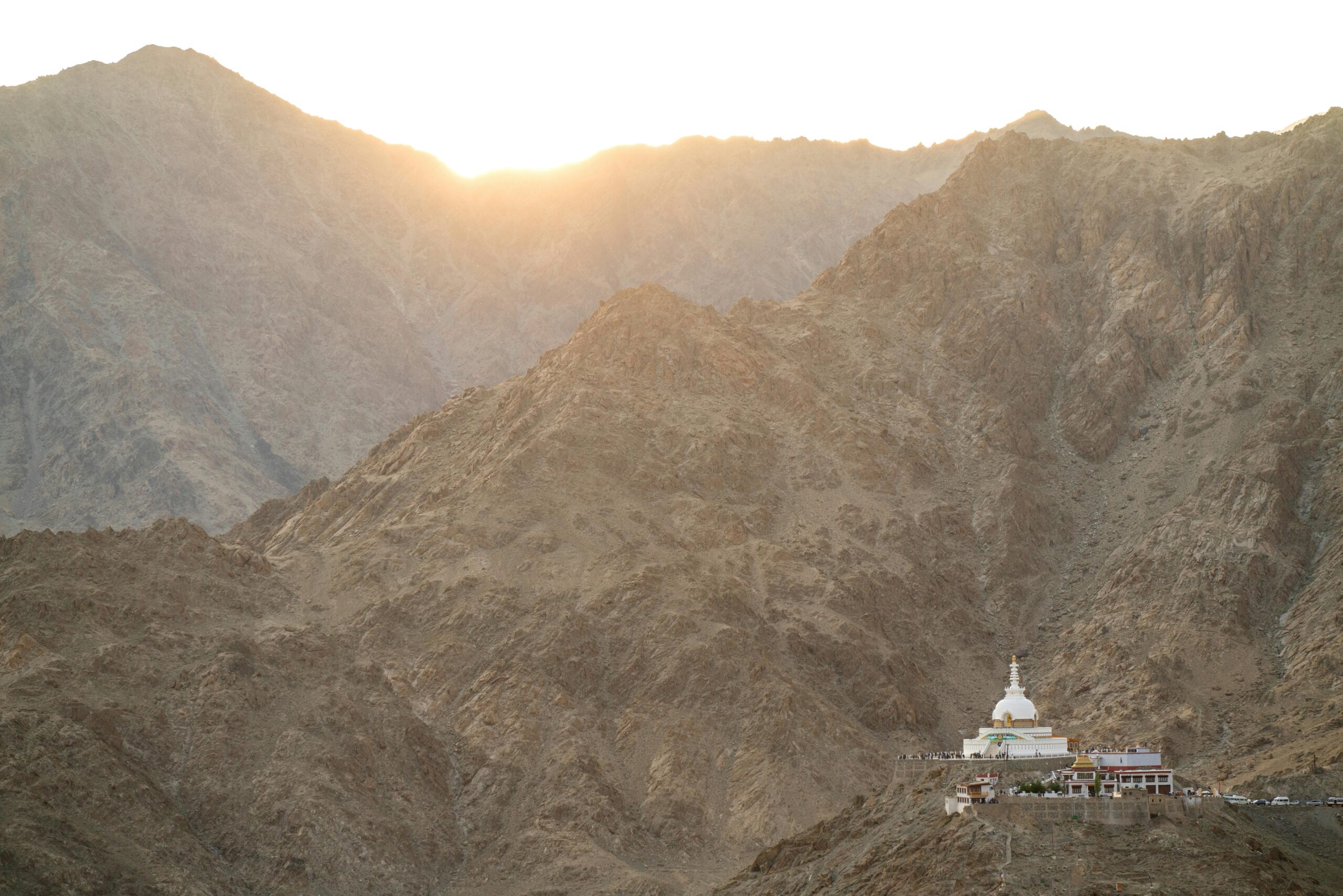
Listening to What the Altitude Remembers — When the Earth Measures Itself Ladakh By Elena Marlowe The journey to Ladakh truly begins when the earth measures itself ladakh, inviting you to listen and feel the altitude’s whispers. Prelude — The Thin Edge of Breath The first mile of sky: how a journey begins in the lungs The first recognition of Ladakh arrives without fanfare—an intake of air that feels like a punctuation mark. At the airport, at the little guesthouse window, on the first slow climb out of town, your lungs register an alteration and your body, in its quiet bureaucratic fashion, begins to negotiate. That negotiation is the beginning of the story. It is not measured in signposts or maps but in breath counts, pauses, and the subtle arithmetic of how many steps per steady inhale. The thin air does not shout; it whispers corrections. You begin to move with a gentleness that would have felt suspicious in lower regions: you walk like someone who has learned the etiquette of waiting. There is a new vocabulary of small acts—sipping water, resting without shame, choosing a warm sweater even in a bright sun—which together form the grammar of survival. This grammar is not merely practical; it is ethical. To travel in such places demands that one adopt a policy of modesty toward the land, an agreement to not extract more than is offered. The lungs are not merely organs here; they are meters. They measure not only oxygen but rhythm, patience, and the capacity for attention. In those first hours and days, the oximeter becomes a kind of translator, and journaling, once a pastime, becomes an instrument of calibration. I record more than scenery: I note how the air tastes at different altitudes, how my hands feel after a day under the maximal sun, how the sound of a pot lid on a stove seems sharper, more insistent. The body, placed under new conditions, re-teaches itself language. This process of relearning is a travel lesson more substantial than any postcard image. Each inhalation is a sentence in a new dialect; each pause a paragraph revealing how the planet is organizing its invisible resources. To treat Ladakh as an object to be consumed is to miss that invitation: the territory invites a becoming—quiet, attentive, slow—that rewards with a clarity no guidebook can promise. I. The Body as a Barometer Breath, pulse, and the arithmetic of survival When you live with altitude as a companion, the body transforms from a private interior into a public instrument. There is an almost musical quality to the way breath rearranges itself: rhythms lengthen, a tendency toward economy takes hold, and even the idea of exertion adopts the conservative tone of a ledger. The measures that matter are small—how many steps between rests, how long to stand and simply let the air settle in the chest—but they add up into a new accounting of movement. This accounting is not about triumph; it is about stewardship. Every guest in Ladakh learns quickly that there is no glory in forcing the pace. The mountain’s patient scale cannot be hurried; instead it asks for negotiated assent. My oximeter’s numbers become a conversation, not a verdict; if the reading dips, I do not view it as failure but as information, a map to be used. Hydration becomes ritual, food a calibration of energy, and sleep a repair shop where the day’s miscalculations are adjusted. There is also the quiet intelligence of listening to others who are native to the region—how their steps have long been tempered by this air, how their laughter is measured by a different currency. To witness a shepherd resting mid-hill or an elder speaking slowly in a courtyard is to observe a culture of optimization that is unshowy and effective. The visitor who learns from these local rhythms finds that survival here is less a matter of equipment and more a matter of relational practice: how you speak to your body, how you attend to its signals, and how you synchronize your movements with the cadence of place. In these ways, altitude becomes a teacher of habit rather than an enemy to be conquered. Altitude as mirror, not challenge Most travel narratives tempt the reader with conquest—some peak scaled, some hardship survived. Ladakh offers a different possibility: a mirror. The thinness of the atmosphere reflects the limits already present in the traveler’s life, and does so with a blunt kindness. In reflection, small pretenses are peeled away; vanity about endurance or speed disappears as quickly as the thin veil of clouds. The mirror is not accusatory; it is clarifying. It shows where your patterns are excessive and where your attention is scant. You realize that some things you carried as strengths are actually liabilities here—rushed speech, excessive luggage, the habit of filling every silence with commentary. The landscape, with its crystalline light and uncompromising altitudes, invites you to shed these habits. The consequence is humility, but not the tame humility of cliché. This is a rigorous humility that becomes almost luminous: an honest assessment of how you stand in the world. This mirrored view also reframes the romantic idea of the solitary traveler. In the presence of altitude, solitude becomes shared: you are not alone in the thinness; others carry it with you. Strangers exchange glances that contain entire conversations about when to rest, whether to press on, and how best to prepare the evening’s fire. The mirror refocuses attention away from the ego and toward the body’s ongoing correspondence with landscape. In that correspondence, humans emerge less as conquerors and more as instruments of perception—temporary devices that the Earth borrows to remember itself. II. Landscapes That Keep Time The Earth’s slow instruments Ladakh is a palimpsest of geologic time. Where another landscape might present itself as a sequence of scenes, here the landscape is a silent memoir. Strata are pages, each fold a sentence about continental collisions, shifting sea beds, and epochs of compression. To walk along a pass is to move through paragraphs of planetary biography. I find that the readerly stance I adopted with breath extends naturally to this geology: patience yields comprehension. Fossilized seashells embedded in a cliff at four thousand meters are not curiosities but proof that time has an astonishing sense of mobility. The ground beneath your boots remembers a humidity that no living memory can recall. There is a pedagogy in this antiquity. The mountains teach by the sheer scale of their indifference to human temporalities; they offer a steadiness that persuades the observer to expand their sense of history. This expansion is not a distraction from the present but a contextualization that deepens it. When you learn that a lake basin once held an ocean, the particular concerns of your itinerary—where to sleep, what path to choose—remain important but small. The landscape’s slow instruments recalibrate the traveler’s moral imagination: what we now consume quickly must be considered against the frame of what endures. Light as a language of altitude Light in Ladakh is a specific dialect: crystalline, sharp, and truthful. It does not flatter. It describes. At altitude the sun’s rays travel through less atmosphere and return with a clarity that exposes form and texture. Colors snap into place with an almost algorithmic precision; shadows delineate themselves like calculations of angle and intention. Paying attention to how light falls—how it changes the color of a rooftop, how it turns a glacial face into a study of planes—becomes an important exercise. It is through light as much as through breath that the altitude speaks. The day is an ongoing lecture about exposure and contrast, and the traveler’s eye, if taught, can learn to translate these signals into practical knowledge: where frost will form, how quickly snow will melt, which slope will hold early shade. Yet light in Ladakh is not merely instrumental. It also carries emotion. At dawn, the valley breathes gold; by evening, warm ochres anchor the sense of time into the body. The quality of light participates in mood, excessing any single sensory register. As with the lungs, one learns to be modest in the face of such generosity: to stand, quietly, and take in the lesson offered. That the planet should provide such an unadorned curriculum is itself a form of abundance. III. The Observatory of Silence Where science meets stillness In places like Hanle and other high-altitude observatories, instruments focus on signals that have traversed enormous distances. Telescopes and radio arrays listen for whispers of ancient light, for the faint tracings of solar and cosmic events. There is a remarkable fellowship between these scientific pursuits and the low, steady rhythms of monastic life nearby. Both are forms of attention: one records frequencies and wavelengths, the other listens to the cadence of prayer. Standing in the neutral space between them, I have often felt the same hush that attends a well-executed measurement—a focused silence that respects both question and answer. Science in such settings is less triumphal than it looks in textbooks; it is humble. Instruments are tuned carefully, observations recorded with a patience that is almost devotional. Simultaneously, the physical stillness of the place—a stillness achieved by altitude as much as by intention—renders the scientific work palpable. Data is not merely numbers; it becomes a narrative thread in the local ecology. When a researcher tells me about the solar wind’s shifting pattern or how atmospheric clarity has varied over years, the anecdote becomes a local history. It is science folded into everyday conversation, and in that folding the categories of knowledge—religious, poetic, empirical—blur into a single practice of sustained attention. Night as the planet’s slow exhalation Night in Ladakh is not simply absence of light but the activati
source https://lifeontheplanetladakh.com/blog/when-the-earth-measures-itself-ladakh/


Comments
Post a Comment