Lower Sham: Quiet Villages Along the Indus Where Ladakhi Life Still Breathes Slowly
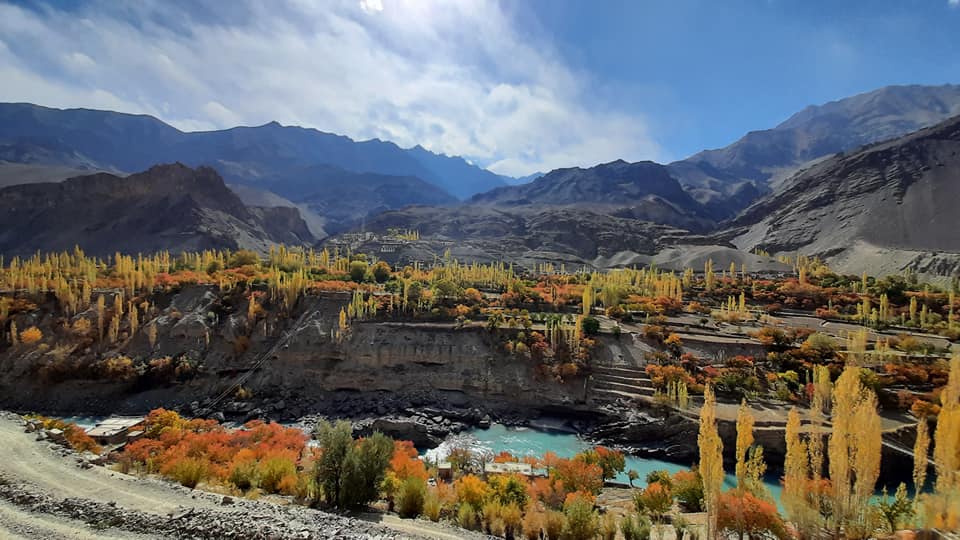
The Valleys Where Ordinary Days Carry the Weight of Centuries By Declan P. O’Connor Opening Reflection: Following the Indus Into Quieter Geographies A river that reshapes your idea of distance and time If you only meet Ladakh on the road between the airport and the cafes of Leh, the region can feel strangely compressed: a place of quick itineraries, checklists, and altitude statistics. Lower Sham, the quieter sweep of the Indus downstream from Leh, refuses that compression. Here the river widens, the light softens, and the distance between two villages is measured less in kilometers than in harvests, family histories, and the rhythm of irrigation channels opening and closing. The geography does something subtle to the traveler: it stretches your sense of time until an ordinary afternoon in a village lane begins to feel as deep as a week elsewhere. Driving west from Leh, the mountains do not become less dramatic, but they become more familiar in their human scale. You see fewer hotel facades and more mud-brick walls patched by hand. Apricot trees lean into the road as if they were part of the traffic system. Small bridges cross the Indus at improbable angles, connecting not tourist “sights” but real lives: a primary school on one side, an orchard on the other, a shrine above. As you enter Lower Sham, you can feel yourself leaving the itinerary of the internet and re-entering something older, slower, and far more demanding of your attention. The first temptation, of course, is to treat these villages as a charming backdrop for your own story: the European traveler who discovers “untouched Ladakh” and returns home with a string of photographs to prove it. Lower Sham is not interested in flattering that narrative. It asks a different question: are you willing to slow down enough to notice how much labor is hidden behind a single bowl of roasted barley, a single basket of apricots, a single courtyard swept before dawn? If you are, the region opens, not as a checklist of monasteries, but as a living corridor of villages along the Indus where Ladakhi life still breathes slowly, even as the outside world rushes past on the highway. Why Lower Sham asks for a different kind of attention than Leh or Nubra Like many visitors, you may arrive in Ladakh having already heard of the more dramatic regions: high-altitude deserts, famous passes, and valley names that show up on every trekking forum. Lower Sham rarely appears in the first line of those fantasies. It has no airport, no cluster of hip cafes where visitors can compare itineraries, and few of the quick visual rewards that a phone screen loves. That is precisely why it matters. This stretch of the Indus valley is not built to entertain you; it is built to carry water, store grain, shelter families, and hold a religious imagination that is older than your passport country itself. To move through it is to be a guest inside someone else’s working landscape, not the protagonist of a travel story. In Leh or in the more photographed valleys, a traveler can maintain a kind of distance: you can admire the mountains from a rooftop, negotiate prices in a market, and then retreat behind a glass window. In Lower Sham, the boundary between observer and participant thins. Staying in a homestay in Alchi or Skurbuchan, you are never more than a few meters from someone’s kitchen fire or from a field that decides whether the year will be generous or tight. Conversation is not a performance for visitors; it is part of the ordinary fabric of the day. When a neighbor drops in for tea, you are sharing oxygen in the same story, whether you understand the language or not. To appreciate Lower Sham, you need a different toolkit than the one you use for fast tourism. You need shoes that are comfortable at walking speed rather than summit speed, ears tuned more to water channels than to road traffic, and an imagination willing to be small in the presence of long-settled communities. This is a place where “offbeat Ladakh” does not mean an edgy secret for social media, but a slower form of hospitality that takes its time to decide how much of itself you are ready to see. When the road becomes a soft border instead of a dividing line The highway that threads through Lower Sham is, on any map, the main artery heading toward Kargil and beyond. Yet for the villages along the Indus, the road is not a hard frontier separating “local life” from “the world outside.” It is something more porous. Children walk across it to school; farmers drive their tractors along it in the early morning; monks hitch rides from one monastery to another when there is a ceremony or a funeral. Trucks carrying goods for distant markets share the tarmac with village buses, and once in a while with a tourist vehicle whose passengers are still adjusting their sunglasses after leaving Leh. From the point of view of a visitor, the road offers choices. You can treat it as a conveyor belt, measuring your success by how quickly you move from one “must-see” to the next. Or you can treat it as a series of invitations, each side road and suspension bridge hinting at a slower world that the map does not detail. The turnoff to Alchi, the deviation to Mangyu, the entrance to Skurbuchan and Achinathang – each is less a detour than a test of whether you are willing to let the neat line of your itinerary fray a little in exchange for something more human. If you take those turnoffs and cross those bridges, the geography of the journey changes. The Indus is no longer a river seen only from above through a car window; it becomes a presence you can hear at night from a homestay, a temperature you can feel in the early morning mist, a direction you unconsciously orient toward when you walk through fields. The road remains, but it loses its power as the dominant story of the landscape. In its place emerges a quieter map: paths trodden by generations between houses and fields, hidden stairs that connect monasteries to villages, and the thin lines of irrigation channels that make the difference between a green orchard and a dry slope. The Character of Lower Sham: What Makes It Different From Upper Sham Softer light, wider river, and the work of ordinary days To understand Lower Sham, it is helpful to think of it not as a rival to the better-known upper valleys, but as a complementary note in a long piece of music. The upper Indus and high-side valleys often feel percussive: dramatic passes, sharp ridgelines, and thin air that forces every breath into your awareness. Lower Sham moves in a slower key. The river has settled into a wider bed, the mountains step back slightly from the water, and the villages spread out across gentler slopes. This does not mean the landscape is tame; it means that the drama is less about survival on the edge and more about the long-term negotiation between land, water, and labor. In the softer light of late afternoon, you notice textures that might be invisible in harsher terrain: the exact way mud-brick walls catch shadows, the pattern of apricot branches framed against the sky, the deliberate geometry of terraces carved by generations who never once used the word “landscape.” Walking through a village lane in Lower Sham, you are surrounded by evidence that beauty here is not an extra layer applied after the work is done. It is the natural byproduct of work itself: a storage room stacked with hay in patterns that would not be out of place in a gallery, a courtyard broomed into clean circles, a row of drying apricots that looks suspiciously like intentional art. This is also a region where rural life is not pitched as a spectacle for visitors. You can see the difference in how people respond to your presence. In some places increasingly shaped by tourism, the village street becomes a kind of stage. In Lower Sham, the rhythm of the day is set by tasks, not by arrivals. You are welcome to walk through that rhythm – to sit on a roof while someone threshes grain, to share tea while a neighbor repairs a wall – but you are not its center. For a European traveler used to being the assumed protagonist of the story, there is a quiet and necessary humility in that realization. How isolation preserved an unhurried religious and agricultural culture Lower Sham sits at a practical crossroads: it is on the road toward Kargil and yet still far enough from the main hubs of Ladakhi tourism that change has been slower. For centuries, its villages have balanced access and distance. Pilgrims and traders passed through, but most never stayed long enough to overwrite local customs. The monasteries in Alchi, Mangyu, and Domkhar became guardians not just of doctrine, but of a visual and architectural language that remembers Kashmir, Central Asia, and local Himalayan craft in the same breath. The fields around Skurbuchan, Achinathang, and Tia hold centuries of trial and error in how to coax grain and fruit from these altitudes with minimal water. Isolation, in this context, has not meant purity in the romanticized sense, but continuity. The same irrigation channels that carry glacial meltwater to barley fields today were dug by ancestors whose names are no longer remembered but whose work remains the basis for every harvest. The small temples that dot the hillsides are not relics lying outside daily life; they are still used, still painted, still maintained, often by the same families who tend the orchards below. This overlap between spiritual and agricultural calendars is what gives Lower Sham its particular density of meaning. Festivals are not primarily performances for visitors; they are punctuation marks in a year whose main sentence is written in mud, seed, and water. For travelers, this continuity presents both a gift and a responsibility. The gift is the chance to see a form of Himalayan life that is neither frozen in time nor entirely remade by outside demand. The responsibility is to recognize that even small ac
source https://lifeontheplanetladakh.com/blog/lower-sham-quiet-villages-indus-ladakhi-life/


Comments
Post a Comment