Land Kept Close: Ladakh Architecture of Attachment
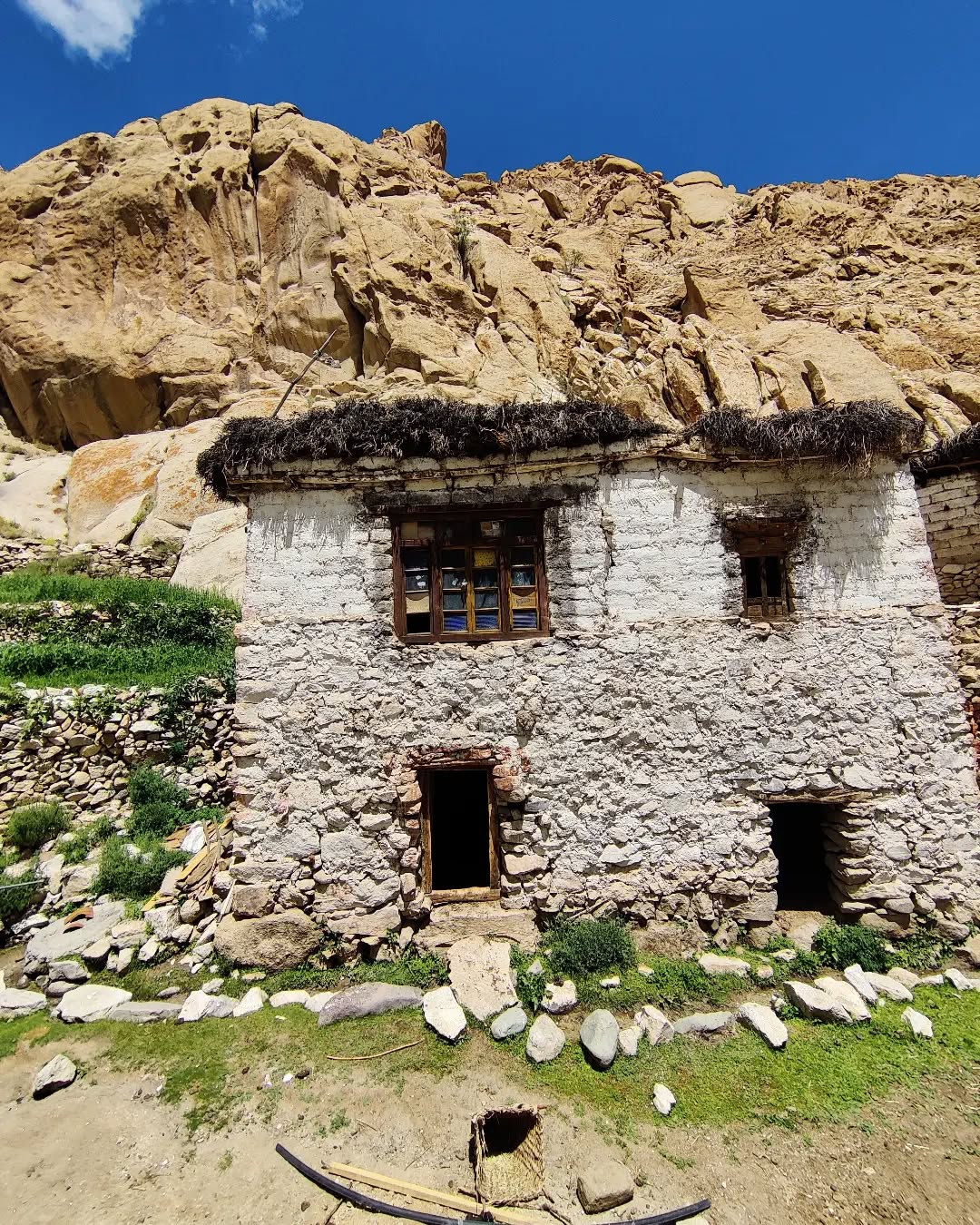
Where Stone Holds Its Breath: Ladakh and the Work of Staying By Sidonie Morel Arriving where the land is kept close The first touch is not wonder, but weight There is a moment, stepping out of a vehicle in Ladakh, when the air feels less like atmosphere and more like a dry, thin cloth pulled taut. It does not billow. It does not soften. It holds its line. The body answers before the mind can compose a sentence: a small tightening in the throat, a faint rasp behind the tongue, the instinct to swallow slowly so the dryness does not scratch you raw. I had come with the usual vocabulary at the ready—valleys, monasteries, the famous names of passes—and found those words arriving too late. The first language here is practical. It is stone underfoot, powdery dust that rises and refuses to settle, the sun that warms the face while the shade keeps its cold. You learn quickly to stand with your shoulders slightly forward, as if to meet the wind on honest terms. And then, before any panorama can take over, a wall does. Not a wall you photograph as “architecture,” but the kind you lean your palm against without thinking. The surface is cool and faintly gritty, mud and stone married in a patient way. Along the top edge, a line of dried earth has cracked into a fine map of stresses—no drama, just a record of weather doing its work. You think: someone has maintained this. Someone has pressed wet clay into gaps with their fingers, smoothed it with the flat of the hand, returned again when it flaked. The wall is not there to impress. It is there to keep what is inside from leaving and what is outside from taking too much. In Ladakh, attachment does not declare itself. It sits quietly in the way buildings are made to remain—how they face the sun, how they turn their backs to wind, how they accept winter without pretending it can be negotiated. Ladakh’s vernacular architecture is not a style; it is a set of decisions that have survived because they were true. And the longer you stay, the more you understand that the landscape is not the point. The point is what people have built to live inside it—what they have built to keep the land close enough to belong to. The house as a method of protection Warmth is guarded like grain Traditional Ladakhi houses do not shout their presence. They sit low and steady, as if they have learned modesty from the mountains. Their walls—stone and mud, thick enough to make sound behave differently—do not merely enclose a family; they regulate life. You step inside and feel the temperature change as a physical event, a subtle easing in the chest. The exterior light drops away, and the room gathers you in the way a thick blanket gathers a body: not softly, but completely. Openings are small, deliberate. A large window would be a generosity the climate cannot afford. Here, light is welcomed, but it must arrive on terms that do not betray heat. You begin to see that protection is not only about keeping danger out; it is about holding precious things in—warmth, quiet, stored food, the steady rhythm of domestic work that continues regardless of what the sky is doing. On cold mornings, you notice the same sequence in different homes: the smell of smoke that clings lightly to wool, the way a kettle is set where it will simmer without fuss, the careful placement of bread so it does not dry too fast. Even the furniture feels like a pact with winter: low, close to the center of the room, arranged for gathering rather than display. The thick walls are the unspoken hosts. They listen. They keep secrets. They hold the heat the way an orchard holds sweetness—slowly, through a long season of restraint. What Europeans often call “simple” in such spaces is not simplicity as an aesthetic; it is concentration. Nothing is careless. A storage corner is not a corner, but a pantry of continuance. A pile of fodder is not clutter, but survival made visible. Ladakh architecture of attachment becomes readable when you stop looking for “design” and start noticing what must be protected: grain from damp, animals from biting cold, water from freezing, bodies from exhaustion. Roofs, beams, and the patient intelligence of repair Then there is the roof—flat, useful, almost shy, though it has the most exposure of any part of the house. From above, roofs can look like pages laid open to the sky. They catch sun, collect dust, offer a place to dry apricots or laundry, serve as a platform where life expands during the gentler months. But the roof is also where the house meets its hardest negotiations: snow weight, melting cycles, sudden rains, relentless sun that cracks and bakes. Before winter, repair becomes a household language. There is an intimacy to it. Someone climbs up with a bucket of mud plaster, a tool improvised from whatever fits the hand, and you hear the slap of wet earth against earth. It is not renovation. It is not improvement. It is devotion expressed in maintenance—an acknowledgment that to stay, you must keep returning to the vulnerable points. In Ladakh, where resources cannot be squandered, the house is not thrown away and replaced when it begins to age. It is cared for like an elder. Beams are checked. Edges are sealed. Tiny cracks are filled before they become stories. The work is not glamorous. It leaves mud under fingernails, aches in the lower back, a faint smell of wet earth that follows you until you wash. But it is the work that makes continuity possible. This is where the concept of “Ladakh village life” becomes tangible: not in festivals or scenic drives, but in the seasonal tasks that keep a household intact. To understand traditional building practices here, you watch hands more than walls. You listen to the small sounds of repair—scraping, tamping, smoothing—as if they are a quiet music that repeats every year, insisting on permanence without ever calling it that. The household as a small ecology Protection is not only built into the structure; it is built into the arrangement of living. The house is a small ecology that includes animals, storage, and human bodies in one long conversation. In some homes, you feel the presence of animals as warmth before you see them. The smell is earthy, not romantic, but honest—hay, wool, dung, the familiar scent of life being kept close. It is tempting, for an outsider, to interpret this closeness as hardship. But closeness is also strategy. In a high-altitude cold desert, separation is expensive. Every step outside in winter costs something. Every unnecessary distance is an invitation for heat to leave and cold to enter. The architecture of belonging here is also the architecture of efficiency, a way of concentrating life so it can endure. Storage spaces are arranged with the kind of respect Europeans reserve for wine cellars. Grain is not merely stored; it is guarded. Fuel is not a casual stack; it is a calendar in physical form, telling you how long you can cook, how much warmth you can afford, how late in the season you can keep water flowing before it turns to stone. When someone offers you tea in such a house, the gesture feels larger than hospitality. It feels like the house itself is approving your presence—allowing you to share, briefly, in a system that has been refined over generations. You begin to sense that “attachment” is not sentimental. It is structural. It is built into how space is organized around survival and care. Walls that watch without calling themselves towers Terraces, lanes, and the steady work of holding soil In another part of the world—the Caucasus, in the mountain villages of Svaneti—towers rise like declarations. They are built to watch, to defend, to announce endurance. Ladakh does not always build its guardians vertically. Here, protection often lies along the ground: in terraces cut into slopes, in retaining walls that hold soil in place, in stone boundaries that do not threaten but persist. Walk through a village and you will notice how paths narrow and widen, how walls lean slightly inward as if to steady themselves against wind. These are not decorative choices. They are responses. A retaining wall is not merely an engineering solution; it is a statement of care: we refuse to let the earth slip away. We will keep this thin strip of soil productive. We will protect what can grow. Terraced fields in Ladakh are not simply agriculture; they are architecture of staying. The stones are fitted with an economy that suggests long familiarity—no wasted movement, no need for perfection, just the correct placement so the wall does its job through seasons of stress. You run your fingers along the edges and feel sharp corners where rock has not been softened by water, only by hand. There is a particular silence around these walls at midday, when even birds seem reluctant to waste energy. In that silence, the walls feel like a low, steady watchfulness. They do not look outward for enemies. They look inward, toward the soil, the water, the crops. They watch what must be protected from erosion, from drought, from neglect. This is how Ladakh’s vernacular architecture extends beyond the house: the village itself is built as a protective network. Irrigation as guardianship If you want to understand how villages are built for winter in Ladakh, you can start with walls. If you want to understand how villages survive summer, you follow water. Irrigation channels run like thin veins across the landscape, sometimes visible, sometimes hidden, always decisive. They tell you where life is allowed to happen. Water here is not background. It is a shared responsibility that shapes social life as firmly as any religious calendar. The channels are narrow, often lined or edged with stone, sometimes reinforced where the current might cut too deeply. They are maintained with the same attention given to roofs: cleaned, repaired, negotiated over. A break in a channel is not simply a technical problem; it is a disruption of the vill
source https://lifeontheplanetladakh.com/blog/ladakh-architecture-land-kept-close/


Comments
Post a Comment