Leh on foot: A Small City a Wide Blue Walk in Leh
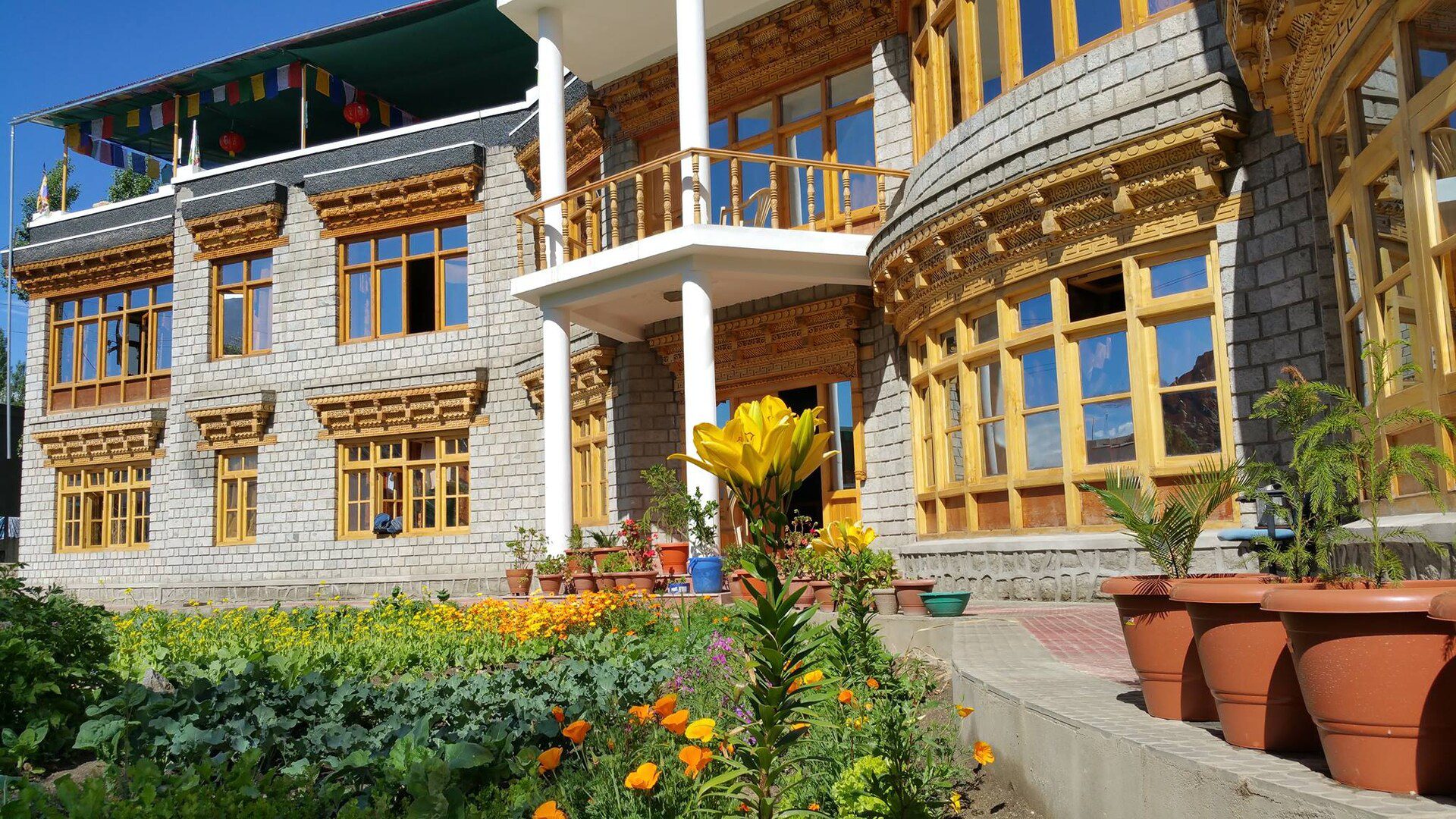
An Afternoon in Leh, Measured in Stone and Blue By Sidonie Morel The Guesthouse Door and the First Honest Pace Where the city begins: at a latch, at a scarf, at the throat The guesthouse does not feel like a starting point until your hand is on the latch. Metal is always more sincere than a plan, especially in thin air. It tells you the truth: the morning warmth is gone, the afternoon brightness is already at work, and your fingers—European fingers used to gentler temperatures—need a second to understand where they are. I step out and the wide blue is immediate, as if the sky has lowered itself to inspect the roofs. Leh on foot begins like this, not with a grand intention, but with the body adjusting to the city’s clear insistence. I wrap my scarf once, then again, and the gesture feels domestic, like tidying a room before guests arrive. Only the guest, here, is the wind. In Leh, even an afternoon can be dry enough to make your mouth feel like paper. The scarf softens that dryness; it also softens my own impatience. Leh on foot asks you to walk as if you mean it. If you hurry, the light turns arrogant. If you slow, the light becomes merely attentive. A courtyard somewhere is being swept; the broom’s rasp on stone is the first rhythm I trust. It is not a sound of tourism, but of living, the kind of sound you recognize in any country if you have ever lived long enough in one place to clean it. On the lane outside, a dog lies in a square of sun with the composure of a true resident. A kettle argues quietly with heat behind a wall. A motorbike passes, then the street re-forms its older pace: not slow, not fast, simply human. I take a few steps and realize that my European habit of “covering distance” is going to be politely refused. Leh on foot does not reward conquest. It rewards noticing: the rough plaster that keeps last night’s cool, the smoothness of a stone worn by decades of soles, the way prayer flags can make color feel like a small act of defiance against so much beige and sky. It is tempting to name the route immediately—market, old town, palace, Changspa Road, Shanti Stupa—but I prefer to let the day name itself. There is a practical pleasure in that choice. When you walk in Leh, your best map is not a line on paper; it is the body’s quiet arithmetic. Shade equals a pause. Thirst equals a turn toward tea. A tightening in the calf equals a gentler pace. Leh on foot makes these equations simple, and because they are simple, they feel elegant. I walk away from the guesthouse with nothing dramatic in mind, only the desire to spend the afternoon as one spends a good fabric: slowly enough to feel its weave. Practical grace: the small habits that make the walk feel lighter There are places where practicality has to be shouted, written in bold letters, repeated until a visitor obeys. Leh does not need that kind of instruction. Leh on foot teaches practicality by sensation. The sun does not “suggest” sunscreen; it makes your eyelids heavy with brightness until you understand, in your own way, that your skin is an instrument and must be treated kindly. The wind does not “advise” layers; it steps into the gap between shirt and collar and gives you a brief, sharp reminder that comfort is something you negotiate, not something you assume. I have learned to keep my pace honest, and honesty is the most useful luxury on a Leh town walk. You will hear talk of altitude in numbers, but the body understands it as a different tempo. You speak in shorter phrases; you climb with less vanity; you accept pauses without embarrassment. I notice this in myself: I stop to watch a woman fold cloth in a doorway, not because I am romantic, but because the pause feels correct. Then I move again, and the movement feels correct too. Leh on foot is full of these small corrections, like adjusting a cuff or smoothing a sleeve. European readers sometimes want a clean sequence: first this, then that, and a neat reward at the end. In Leh, the reward is often a minor comfort arriving at the right moment. A stretch of shade appears just as your shoulders begin to tense. A small shop front offers water when your mouth starts to feel chalky. An apricot smell drifts from somewhere and makes you realize you are hungry in the slow, civilized way, not the rushed way. These are not dramatic events, but they change the quality of the afternoon. So I carry only what keeps the walk simple: a bottle of water, a few notes folded in the pocket where they will not crumble, and a willingness to stop without guilt. Leh on foot asks you to be practical in the same way it asks you to be elegant: by choosing what is necessary and leaving the rest behind. As the street grows busier and the soundscape thickens—voices, shutters, the thin ring of metal against metal—I know I am drifting toward the market, not because I chased it, but because the city’s pulse has begun to guide my feet. Leh Market, Where Color Does the Talking The bazaar is not a sight; it is a texture you move through You hear the market before you see it, and that feels right. Leh Market does not present itself like an object to be admired from a distance; it is a living strip of sound and friction. On a day when the wide blue seems to press down on everything, the bazaar presses back with human noise—bargaining, laughter, the crisp snap of a plastic bag, the soft thud of fruit being set down. Walking in Leh brings you into this sound slowly, as if you are entering a room where a conversation is already underway and you must find your place without interrupting. Leh on foot changes the market’s scale. If you arrived by car, you might be tempted to treat it as a stop. On foot, it becomes an environment. The stalls and shops compress the afternoon into close quarters. Wool and leather and metal and spice sit beside each other like different dialects of the same language. There are scarves with a softness that makes you want to forget about weather entirely. There are copper pots that hold the light in their bellies. There are packets of masala whose smell is strong enough to feel like a hand on your shoulder. European eyes often search for the “authentic” quickly, as if authenticity were a single object hidden somewhere among the goods. But the market’s authenticity is not a souvenir; it is in the choreography. People pass each other with a small turn of the shoulder that says, I see you. A shopkeeper talks fast, then shrugs, then smiles again, as if the entire bargain were less important than the fact that both of you are alive in the same afternoon. Leh on foot makes these gestures legible, because you are moving at the same speed as everyone else. I stop at a row of textiles and touch fabric before I decide what I think. The weave tells a story more quickly than a label. Some cloth is all surface, flattering and insincere. Some has weight, the kind that falls properly and does not beg for attention. I feel my own mood shift with the texture. This is how the market speaks: through small, tactile truths. Walking in Leh Market, I realize I am not collecting objects; I am collecting evidence of how the city holds itself together—through trade, through patience, through the everyday art of making do without making a spectacle of it. Above the roofs, the wide blue remains imperturbable, but here below, everything moves. A dog threads through ankles. A child runs with the seriousness of a small messenger. A monk steps aside for a cart. Leh on foot in the bazaar is less a route than a slow immersion, and when I finally find myself near the center of the market, I feel as if I have been folded into the city’s fabric, not merely invited to observe it. Little purchases, big reliefs: how the market makes the walk easier It would be dishonest to pretend that the market is only poetry. A bazaar is also an economy, and an economy has its practical comfort: it supplies what your body needs without ceremony. Leh on foot makes you aware of these needs quickly. The throat dries. The sun insists. The dust finds the edges of your shoes. In the market, solutions appear in modest forms: a bottle of water held in a refrigerator that hums like a small engine of mercy; a pair of socks thick enough to soften your step; a scarf that can be pulled up when the wind becomes too confident. I watch a woman choose vegetables with the care of someone composing a meal, not a display. Her fingers test firmness; her eyes are precise. The gesture reminds me of European markets, but the light here makes everything sharper and the air makes every smell more immediate. I find myself hungry again—not for quantity, but for warmth. The idea of a café inside the Leh Market begins to feel inevitable, like the next sentence in a paragraph. Leh on foot does this: it turns appetite into a compass. At a stall of dried fruit, apricots sit like small suns, wrinkled and sweet, their sugar concentrated by weather. I buy a handful and the vendor ties the bag with a quick twist, a movement so practiced it has the grace of calligraphy. I taste one and the sweetness feels less like indulgence than like fuel. The market is full of these understated exchanges. Money changes hands; so does a sort of mutual recognition. You are not the first traveler; you are simply today’s traveler. The most practical thing the market offers is not an object but a change in your pace. You cannot rush in a crowd without becoming rude. So the market forces you to slow, and in that slowing your breath becomes steadier. Leh on foot often works this way: the city imposes a rhythm, and the rhythm becomes care. By the time I drift toward the café tucked among the stalls, I feel my body recalibrated. The wide blue is still strong above, but my attention is stronger now, and I am ready to sit for a moment—not as a tourist taking a break, but as a pedestrian allowing the afternoon to settle into its proper shape. A Market Café, and the Art of Not Moving Te
source https://lifeontheplanetladakh.com/blog/leh-on-foot/


Comments
Post a Comment