Nubra Valley villages travel guide From Khardong to Turtuk
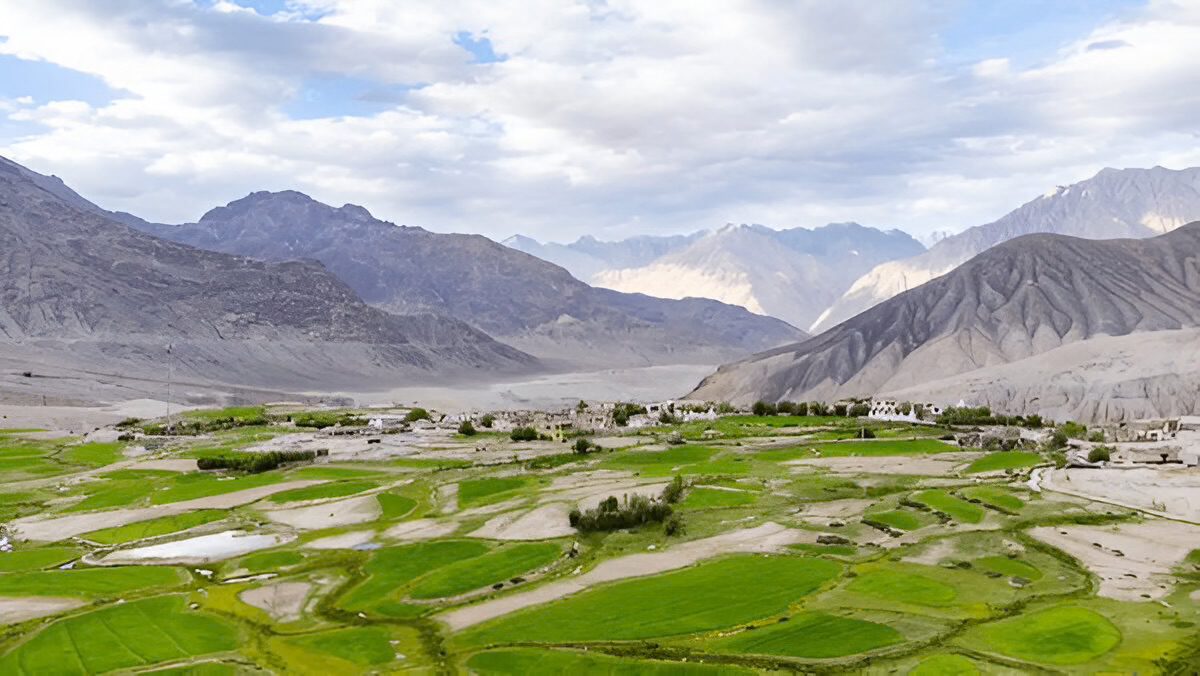
Where Quiet Roads Shape the Heart of Nubra Valley By Declan P. O’Connor I. Opening Reflections: Entering a Valley of Two Rivers The First Descent from Khardung La On the far side of the high pass, the air changes before the scenery does. The road that drops from Khardung La into Nubra Valley does not simply move you from one altitude to another; it feels as if it is lowering you into a different register of sound, light, and time. The city behind you is still busy, full of horns, itineraries, and signal bars that flicker in and out. Ahead, the valley opens slowly, not with a single cinematic vista but with a series of small revelations: a string of whitewashed chortens, a ribbon of water glinting in the distance, the first patchwork of fields pressed against bare rock. Nubra Valley is not a single landscape but a meeting point of many: glaciers feeding rivers, rivers feeding villages, villages keeping cultures alive that once travelled all the way to Central Asia. As you descend, you begin to understand why this place has always mattered more than its map size suggests. It has hosted caravans and pilgrims, soldiers and farmers, monks and schoolchildren. The further you drive, the more the road feels less like infrastructure and more like a slow, grey thread stitching together lives along the Shyok and Nubra rivers. How Landscapes Become Cultures in Motion At first glance, the valley’s geography seems to dominate the story: the broad, braided rivers, the sheer cliffs, the improbable apricot trees that somehow thrive in the cold desert. Yet the more time you spend moving from one settlement to another, the more you realise that Nubra Valley is less about scenery and more about circulation. Ideas move here. Languages shift slightly from village to village. Religious traditions share walls, festivals, and sometimes even family trees. It is a place where the old Silk Route never fully disappeared; it simply slowed down and became local. The road from Khardong to Turtuk is therefore not just a drive through a postcard. It is a long, looping conversation between mountain and river, between monastic courtyards and barley fields, between Ladakhi, Balti, and the quiet codes of hospitality that still matter more than Wi-Fi passwords. As you follow the asphalt northwards, you begin to understand each village as a different answer to the same question: how do people learn to live, and keep living, in such a demanding yet generous landscape? II. Khardong: A Village that Watches the Pass Life Above the Valley Floor Before most visitors even realise it, they have already passed the first of Nubra’s high-set guardians. Khardong sits above the main valley floor, closer in spirit to the pass than to the river, as if it were still listening for the sound of caravan bells on the horizon. Houses cluster along the slopes in a way that looks precarious from a distance, but once you are walking the lanes, it feels surprisingly logical. Each courtyard, each rooftop, each small patch of field seems angled to catch a fragment of sun or a view onto the mountains. Life here is practical, unsentimental, and adapted to altitude. People think in terms of fuel, fodder, snowmelt, and wall thickness before they think of itineraries and hashtags. Yet this does not mean that the village is closed to the world. On the contrary, many families have stories of relatives working in Leh, in the army, or even abroad. Children grow up with one foot in an ancestral rhythm of planting and harvesting, and another in an era of school exams and video calls that cut out whenever the signal tires of climbing the mountain. From a cultural perspective, Khardong offers a first glimpse of how Nubra Valley negotiates between the old and the new without losing its footing. The Old Routes and the Quiet Rhythm of High-Altitude Living If you pause for a day rather than a few minutes, the quieter logic of Khardong becomes clearer. Paths that appear aimless from the road turn out to be careful lines connecting water to house, house to field, field to prayer flag. Stories about the old trade routes still surface in conversation, not as nostalgic set pieces but as practical memories: which slope was safest in a heavy snow year, where travellers once sheltered, when grain used to arrive from far beyond the current border. The village’s relationship with the pass is not romantic; it is about survival, supply, and sometimes sudden isolation. Yet in the evenings, when the wind drops and the last vehicle’s echo fades, there is a calm that feels almost deliberate. Families gather on flat roofs, children chase each other along stone walls, and the village seems to lean back and watch the sky for a while. In that pause, you can sense why people stay, and why the road that continues toward Nubra Valley is not only an escape route to somewhere more famous, but also a lifeline back to this hillside above the river. III. Sumur: The Stillness Around Samstanling Monastic Silences and Village Life By the time you reach Sumur, the valley has widened and your shoulders have dropped a little. The tight bends of the descent give way to longer, more generous stretches of road, and the air seems to carry more moisture, more birdsong, more of the low, warm sounds of village life. Sumur is known to many visitors because of Samstanling Monastery, but to think of it as simply a monastic stop is to miss its deeper character. Here, the religious and the everyday sit side by side in a way that is understated but unmistakable. The monastery rises above the fields, with prayer flags stretching like delicate bridges between building and cliff. Inside, the air is thick with butter lamp smoke and the slow murmur of chants. Outside, just a short walk away, women work in the fields, men carry tools along irrigation channels, and schoolchildren swing their backpacks with the familiar impatience of the end of the day. The silences of Samstanling are not removed from village life; they are part of its rhythm, shaping how time is felt, when decisions are made, and how misfortune or good harvests are interpreted. Why Sumur Became a Cultural Anchor of Nubra Sumur’s role as a cultural anchor in Nubra Valley is not something that arrived with tourism. Long before guesthouses appeared, the village functioned as a kind of spiritual and social reference point for surrounding settlements. Stories, advice, and rituals travelled here along with goods and greetings. In that sense, Sumur has served as an informal archive of memories: the place where elders remember the exact year of a difficult winter, where monks can recount how certain practices came to the valley, and where families return for major life events even after they move closer to towns and jobs elsewhere. For visitors, this anchoring role is not always obvious at first glance. It reveals itself in small moments: the way a farmer pauses to speak with a monk on the path, the ease with which neighbours step into each other’s courtyards, the respect given to seasonal and religious calendars. When you walk slowly through Sumur, you begin to see that it is less a picturesque backdrop and more a living institution in its own right, one that helps hold together both the spiritual and the practical threads of the valley. IV. Kyagar: A Settlement Between Memory and Movement Where Trade Routes Once Converged Driving from Sumur to Kyagar, you can feel the valley narrowing and widening, as if it is breathing. Kyagar itself appears modest: clusters of homes, stretches of farmland, the everyday details of rural Ladakh. Yet beneath this apparent simplicity lies a history shaped by movement. Trade routes once converged in this part of Nubra Valley, linking it to regions that now lie across guarded borders and on distant maps. While the caravans have gone, their echo remains in the way people here talk about distance, opportunity, and risk. Older residents speak of journeys that would now be impossible, of relatives who settled in places that are no longer mere stops on a shared route, but separate worlds on the far side of lines drawn by politics. The geography that once allowed movement now sometimes restricts it, yet the memory of that openness continues to influence how people in Kyagar view visitors, trade, and the future. The village stands as a reminder that even quiet settlements have long, outward-looking histories, and that the road you travel today is just one layer over older paths. The Changing Tapestry of Daily Life Daily life in Kyagar, like elsewhere in Nubra Valley, is changing in ways that are subtle rather than dramatic. Fields still need tending, livestock still requires care, and festivals still bring together families scattered by work and study. At the same time, smartphones glow in kitchens, weather forecasts are checked before planting, and conversations about children’s futures increasingly include words like “degree,” “training,” and “abroad.” The tapestry of life here is being rewoven, but not from scratch; new threads are being added without entirely removing the old ones. Visitors who stay more than a single night see how these layers overlap. A teenager might help his parents with irrigation during the day, log on to watch a football match in the evening, and then, without any contradiction, join his family at the prayer room shrine before bed. This coexistence is perhaps the most striking aspect of Kyagar: the ability to absorb change without losing the core patterns of cooperation, seasonal work, and shared responsibility that have defined the village for generations. V. Panamik: Steam Rising from the Edges of the Valley Hot Springs and the Science of Cold Deserts Panamik is often introduced to outsiders through a single detail: its hot springs. Photographs show pools surrounded by bare rock, wisps of steam drifting into cold air, and the familiar juxtaposition of thermal water in a high-altitude desert. But t
source https://lifeontheplanetladakh.com/blog/nubra-valley-villages-khardong-turtuk/


Comments
Post a Comment