Between Pass and Water: A Road to Pangong
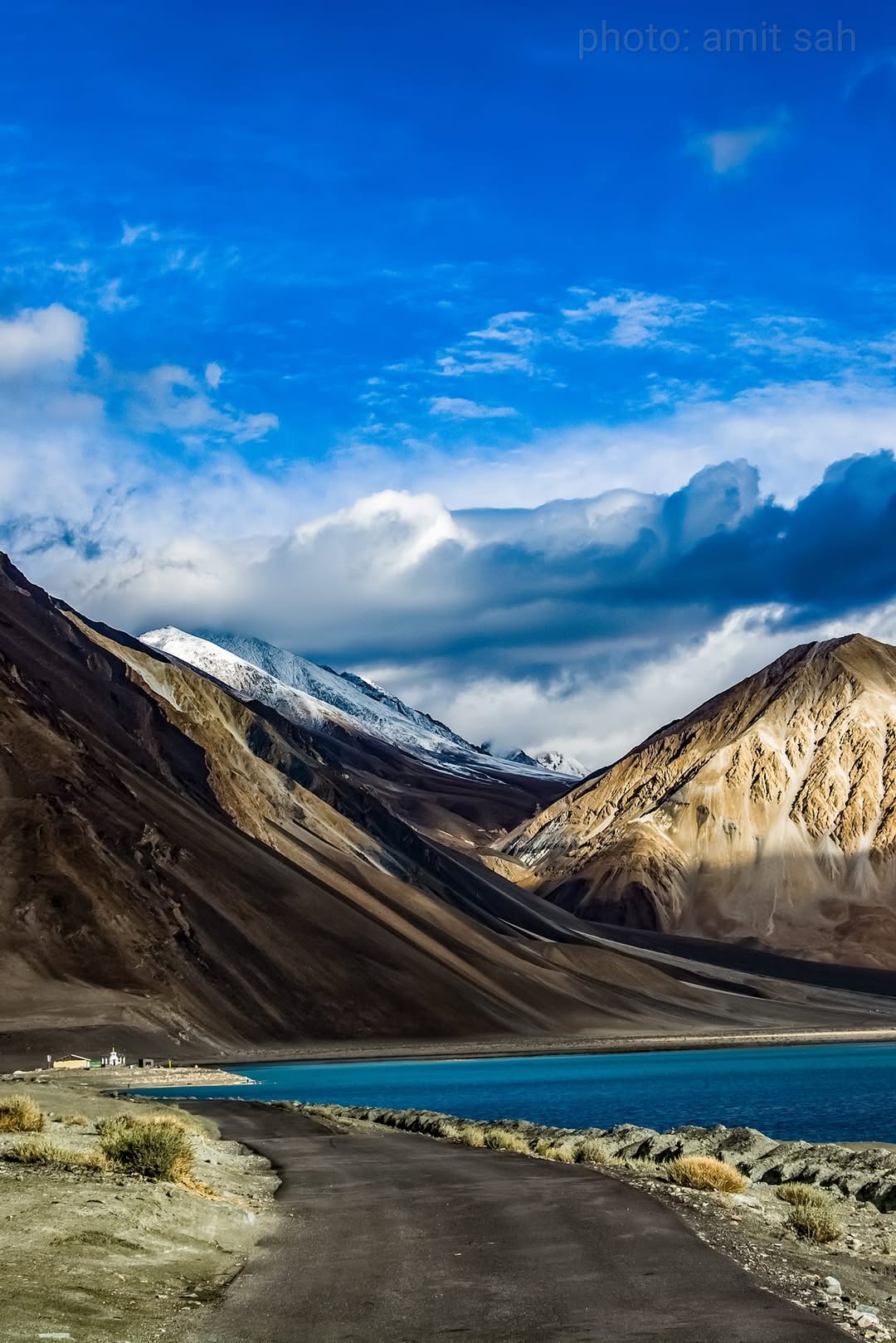
A Road Between Breath and Blue By Sidonie Morel Leh, Before the Engine Starts Morning metal and the first practical decisions In Leh, departure is rarely dramatic. It is, more often, a small sequence of checks performed in a cold courtyard: the boot lifted, the spare tyre tapped, a water bottle weighed in the hand as if the body already knows it will need it. The car is usually a white taxi or an Innova that has done this route too many times to pretend it is new. The driver moves quietly, without ceremony. Your bag is placed where it will not shift on broken tarmac. A blanket might be folded in the back seat; not for comfort, but because the air above the pass can turn sharp even in sunlight. This is where the Leh to Pangong Lake road trip begins to reveal its real shape: not as a “day excursion,” but as a string of thresholds. The first is not Chang La, not the lake. It is the moment you accept that the day will be governed by road, altitude, and small permissions. If you are travelling in season, someone will ask for copies of your Inner Line Permit; if you are travelling out of season, someone will ask whether the pass is open at all. Even when everything is in order, there is a faint administrative rhythm to the journey—photocopies in a folder, names spelled out clearly, a pen passed around the car as naturally as a packet of biscuits. Many visitors do what is sensible and spend time in Leh before going anywhere higher. The city sits above 3,500 metres, which is already enough to make a brisk walk feel oddly deliberate. The first days can be unglamorous: a headache at breakfast, a slower climb up stairs, a new respect for the pace of local life. On the morning of departure, you see the consequences of that acclimatisation in small ways. People who have waited a day or two speak normally, laugh without stopping for air, and drink tea as if it is simply tea. People who have arrived the night before often sit very still, watching the road ahead as if it might be negotiated by willpower alone. Outside the hotel gate, Leh is already awake. Shopfront shutters lift. A dog crosses the road with the authority of someone who knows traffic will hesitate. In the light, the town’s edges are visible: low walls of mud and stone, poplars, and beyond them the pale, hard slopes that make vegetation look like an afterthought. The driver may say little. The engine warms. The first turn of the key is not a beginning in the romantic sense, but it is a clear signal: from this point, the day will be decided by what the road allows. The City Falls Away, and the Plateau Takes Over Leaving the ordinary oxygen behind The first hour out of Leh can feel almost familiar: road signs, small roadside stalls, the occasional cluster of houses. Then the built world thins, and the landscape begins to take over with a firmness that is difficult to ignore. The light here is not gentle. It hits stone and dust without much softness, and the air has a dryness that sits at the back of the throat. Through the window, the surface of the land looks worked by wind and water rather than by people: loose gravel, pale sand, and the occasional ribbon of green along a stream where willows hold on. The car’s interior becomes its own microclimate. Sun warms the glass; the floor stays cold. A scarf is pulled up, then put down again. Someone opens a sweet or a piece of dried fruit and the smell briefly changes the air inside the cabin—apricot, sugar, plastic wrap—before the road asserts itself again. Conversation, if it happens, tends to be practical: how long to the pass, whether the tea stall is open, whether the road is better this year. When the road begins to lift, voices often get quieter. It is not reverence. It is breathing. There are stretches where the tarmac is intact and the car hums with steady speed. Then, without warning, the surface breaks into patched gravel and potholes that force the driver into a careful slalom. That change in texture is one of the route’s recurring themes. The Leh to Pangong Lake road trip is often described as a “drive,” but it is not a smooth European drive. It is a negotiation. You feel it in the way your shoulder meets the door on sharp bends, in the way a bottle rolls and is caught, in the way a passenger’s hand rests briefly on the seat in front when the car drops into a rough section. Outside, traffic is a mixture of local vehicles, tourist taxis, and military trucks. The army presence is not a background detail here; it is part of the day’s visible reality. Convoys move with a certain force, and private cars give way quickly. At times the road narrows to a single lane, and patience becomes less of a virtue than a survival tactic. Dust rises behind vehicles and hangs in the air, catching sunlight. When you stop—perhaps to let an engine cool, perhaps to take a photograph—dust settles on your shoes and the cuffs of trousers in a fine layer that feels almost like powder on the skin. Checkposts and the brief rituals of passage Checkposts arrive without drama: a gate, a barrier, a low building, a man in uniform who knows exactly how many cars will pass today and exactly how long it should take to write them down. Papers are handed over. Names are copied into a ledger. The process is usually polite, efficient, and faintly impersonal, as if the landscape itself has instructed people to conserve effort. There is often a moment of waiting where you look at the mountains in front of you and realise that the road is not the only line being managed here. For travellers, these stops can feel like interruptions. For the route, they are part of its structure. The car moves, then it pauses. The body notices the pause. Someone stretches their fingers; someone adjusts a jacket. The driver might step out to speak with another driver, the conversation carried by the tone rather than the content. The barrier lifts, and the car continues. That alternation—movement and stopping—shapes the day as much as altitude does. It is worth noticing what happens in the car after each checkpost. The driver’s focus sharpens. Passengers often fall silent. The road begins to climb more insistently, and the surroundings look less like a valley and more like a corridor of rock. You pass prayer flags tied to poles or strung between stones, their fabric snapped into frayed ribbons by wind. You pass small chortens or heaps of stones that suggest people have been marking this route long before it became a tourist itinerary. These are not decorative. They are signs of how humans behave when a landscape is bigger than their plans: they leave small markers, they make small requests. Chang La: The Pass That Tightens Everything Snow walls, thin air, and the economy of movement Chang La is often introduced with a number—around 5,360 metres—and the number is not just for boasting rights. It is the simplest explanation for why people get out of the car and immediately move differently. Steps become shorter. Gestures become economical. A light bag feels heavier than expected. A laugh ends early. The air has a bite that is not purely cold; it is also the dryness of altitude, the way moisture seems to leave the body faster than you can replace it. At the top, there is often snow even when Leh is bright and dry. Snow banks are pushed back by bulldozers into rough walls, greyed by dust and exhaust. The surface is uneven, packed and slick. The pass is not a clean viewpoint; it is a working place. Vehicles pull in, engines idle, and people step out to take in the signboard that announces the altitude. There are prayer flags, always—strung thickly, fluttering at a speed that makes fabric look like a tool rather than a decoration. The wind can be blunt. It presses into the ears. It turns cheeks red quickly. If you stay outside too long, your fingers start to lose their certainty on the zip of a jacket. There is usually tea available: sweet, milky, served in small cups that warm the hand. Sometimes there are instant noodles. The smell of fuel, wet wool, and frying oil mixes in the air. This is not a “mountain café” in the European sense; it is a survival pause. People drink quickly, take photographs quickly, and return to the car with the brisk urgency of those who understand, even without being told, that this is not a place for lingering. The driver watches. Drivers always watch. They know who is struggling and who is simply cold. High passes create a particular kind of camaraderie between strangers. People exchange small advice without being asked: drink water, do not run, take it slow. Someone offers a seat to someone who looks unsteady. A young man sits on a low wall and stares at his shoes, counting his breath. A couple pose with the signboard and then stand quietly, their bodies clearly working harder than their smiles suggest. On Chang La, the body is not a private matter. It is visible. The pass as a hinge in the day From the driver’s seat, Chang La is less a destination than a hinge. It is the point at which the road’s character changes. The climb demands attention—tight turns, patches of ice, sections where the surface is broken or washed out. The descent demands a different kind of care: brakes, speed control, the unpredictability of gravel. At the pass, you can feel that transition even before the road drops away. The car’s engine changes pitch. The driver’s hands settle on the wheel with a particular steadiness. If the weather turns, Chang La is where the day can suddenly feel precarious. Cloud can arrive quickly, bringing snow or sleet that changes visibility and traction. Even without a storm, sunlight can be harsh enough to trick you into underestimating cold. When wind rises, it lifts grit that stings the eyes. People squint, hunch, pull their collars up. The pass has a way of stripping away the theatrical side of travel. It insists on function. And yet, despite its bluntness, Chang La also offers a certain clarity. The landscape
source https://lifeontheplanetladakh.com/blog/leh-to-pangong-road-trip/


Comments
Post a Comment