The Melt That Reached the Kitchen
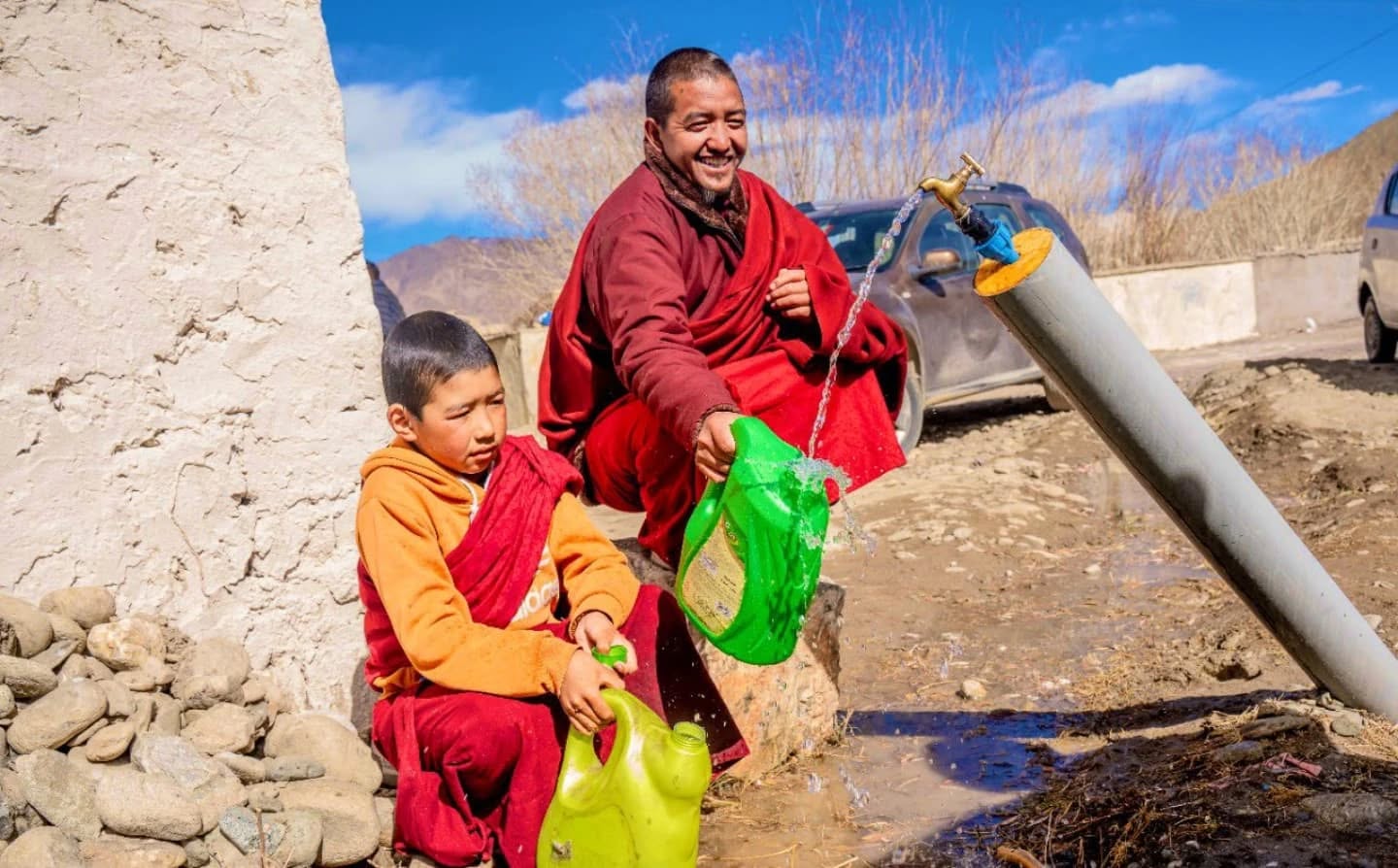
When the Bucket Is Lighter Than It Should Be By Sidonie Morel The first sound is metal Before the sun, the day already has its weight The morning begins with a small violence of sound: metal against metal, the quick clink of a bucket handle, the dull bump of a lid set down too firmly because hands are still half-asleep. In Ladakh, early light is never sentimental. It comes clean and pale, a thin blade along the edge of a wall, and it shows you things you did not ask to see: the powdery dryness on a doorstep, the faint crack in the plaster that yesterday’s wind widened by a millimeter, the way yesterday’s tea leaves have been swept into a corner as if they might be useful again. I wake to those noises in a house where the kitchen is the warmest room and also the most honest. A stove that has known many winters holds onto heat like a stubborn animal; the floor feels kinder here, less like a slab and more like a surface that has learned our steps. In the half-dark, you learn what matters by touch: the rough grain of the wooden ladle, the sting of cold water if it arrives too suddenly, the soft give of dough under a palm that remembers its own work. This is where climate becomes intimate. The melt is not a headline. It is a question asked with a glance toward the bucket: How much did we get today? A few years ago, that question lived in the fields and channels, out where water ran in narrow, obedient lines. Now it lives beside the stove. The melt has reached the kitchen—not as a metaphor, but as a change in routine so small you might miss it if you were looking for drama. On a cold morning in late spring, the water should have a certain bite, a certain steadiness. Instead, it arrives in a way that feels uncertain—sometimes earlier, sometimes later—like a guest who has forgotten the roads. In some villages, people speak quietly of glacier melt and snowlines, but more often they speak of the tap that used to run and now thinks twice, of the channel that used to carry water at a predictable hour and now comes as it pleases. The practical vocabulary is more reliable than any grand term: turn, flow, timing, share, repair. Outside, you can still see white high on the ridges, and a visitor might mistake that for reassurance. But the first proof of change is never up there; it is down here, where water is measured in cups and the day’s rhythm depends on whether a pot can be filled without apology. The long route from ice to pot What a channel carries besides water If you want to understand what is happening in Ladakh, you have to follow the water like a patient person follows a story told by someone shy. It does not speak all at once. It arrives in fragments, in interruptions, in the awkward pauses between one season and another. The route is deceptively simple: snow and ice, meltwater, stream, channel, tank, tap, bucket, pot. But each link in that chain is vulnerable to heat, to debris, to timing, to the small failures that accumulate when you depend on a system built for a different climate. A channel is not just a line in the earth; it is a piece of social agreement made visible. It reflects the old, intricate negotiations that let a dry place remain inhabited: who receives water first, who waits, who repairs, who pays, who remembers how to mend a breach with stones and mud and a kind of practiced stubbornness. In a village lane, the channel may run beside the path like a narrow companion. In the bright hours it looks harmless—just a thin ribbon with a little sparkle in it, the occasional leaf caught in the current. But listen closely and you hear another sound beneath the water: the scrape of grit, the faint hiss of silt. Meltwater can carry more sediment as it rushes faster or arrives in sudden pulses, and the channel has to swallow what it did not expect. When it clogs, the burden returns to hands. Someone lifts a stone, digs out a pocket of mud, pushes a clump of debris aside. It is not heroic. It is Tuesday. Glacier melt is often described as abundance followed by loss, and there is truth in that arc: periods when meltwater surges, then years when the reserve thins, the system falters, and the timing becomes unreliable. Yet the first experience of that curve is not abundance. It is irregularity. A farmer cannot irrigate by poetry. She needs a certain hour, a certain flow, a certain promise. When that promise wavers, the uncertainty trickles into everything else—into planting dates, into fodder, into how long you can leave the house to attend a wedding or a funeral without missing your water turn. We like to imagine water as a purely natural fact, but in Ladakh it is already a managed relationship—between altitude and household, between winter and work. Climate change does not create that relationship; it interrupts it. And interruptions, here, are not abstract. They show up as cracked lips in dry wind, as the ache in a shoulder from carrying, as the unspoken calculation of how much tea can be served before you begin to feel wasteful. The kitchen keeps the ledger Cooking as quiet adaptation In the kitchen, adaptation arrives without speeches. It is a series of small decisions made with a plain face. Someone rinses vegetables in a bowl instead of under a running tap and keeps the rinse water for a plant. Someone washes dishes with a little less foam, not because soap is precious—though it can be—but because water is. Someone learns to boil more efficiently, to cover a pot sooner, to plan meals around what requires less washing. The word “efficiency” sounds managerial, almost rude in a room that smells of butter tea, but the practice is gentle. It is simply the art of not being careless. There is a kind of domestic intelligence that doesn’t announce itself. It lives in the way a woman pours water from one vessel to another so cleanly you barely see the movement, in the way she swirls a cup to catch the last usable drops, in the way she scrapes dough from a bowl with a practiced edge of her hand so the bowl needs less scrubbing. These are not “tips.” They are habits shaped over generations in an arid landscape, now tightened by a new scarcity that is less predictable and therefore more exhausting. On certain days, the water has a faint earthiness that wasn’t there before—silt from upstream disturbance, or the taste of minerals more pronounced when flow is lower. You learn to notice taste as part of weather. A child complains that the tea is different, and an elder says nothing but sets the kettle down again, as if repetition might restore the old flavor. It is tempting, as an outsider, to romanticize this restraint. I try not to. The restraint is not aesthetic; it is necessary. And necessity has a way of shaping manners. Guests are still offered tea, still offered food, still invited into warmth. Hospitality does not vanish because water is scarce. Instead, the host becomes more attentive to the hidden cost of generosity. The cups are smaller. The washing is more careful. The smile stays the same; the calculation behind it grows heavier. In European kitchens, scarcity often arrives as a concept: a documentary, a policy debate, a distant photograph of a dry riverbed. Here, the melt touches a ladle. It touches the bread board. It touches the sink. It turns a private room into a climate archive without ever asking permission. What people say when they do not want to be dramatic Language that keeps its footing In Ladakh, conversation about water often begins as a complaint and then, quickly, becomes a plan. “The tap is weak today,” someone says, and within a minute there is a discussion of whose turn it is, whether the channel needs cleaning, whether the pipe has frozen overnight even though it should not freeze anymore at this point in the season. The talk is practical, but beneath it there is a shifting sense of what counts as normal. “The winter was short,” a man tells me with the tone you might use to describe a neighbor who has become unreliable. He does not say “global warming.” He says, “It didn’t stay.” As if winter is a guest that used to linger politely and now leaves early, without finishing its tea. Another person says, “The snowline went up.” Not as an observation for tourists, but as a fact that changes how you live. Snowline is not scenery; it is storage. It is the bank you cannot visit but depend on nonetheless. When it retreats, you feel the absence in places that are not obvious: in the dryness of fodder, in the timing of irrigation, in the stress that rises when two needs overlap and water cannot be everywhere at once. Sometimes the talk becomes more pointed. Someone mentions the shrinking glacier, the strange warmth, the dust storms that feel harsher. Someone else shrugs, not because they do not believe it, but because belief is not a tool. Tools are shovels, stones, spare pipe fittings, a phone call to a cousin who knows how to fix a leak, a quick meeting among neighbors to decide who will repair a breach before the flow is lost for the day. There is a kind of dignity in this refusal to dramatize. It is not denial. It is proportion. People here have lived with risk for a long time: sudden floods, landslides, harsh winters, fragile harvests. The melt is frightening not because it introduces danger—danger is familiar—but because it dissolves patterns. It unthreads the season. And when the pattern is gone, you cannot prepare with the same confidence. You begin to live in response mode, and response mode is tiring in a way that no single crisis is. Heat on the tongue, dust on the windowsill Small sensory proofs of a large shift By midday, the sun is sharp enough to make even stone feel hot to the touch. In the courtyard, a wet patch dries almost instantly, leaving behind a pale ring, a tiny geography of evaporation. Dust gathers in corners with an insistence that feels new—finer, more persistent, as if the air has learned a different texture. A woman lifts a blanket in
source https://lifeontheplanetladakh.com/blog/ladakh-water-crisis/


Comments
Post a Comment