The White Between Footsteps: Walking Ladakh in Winter
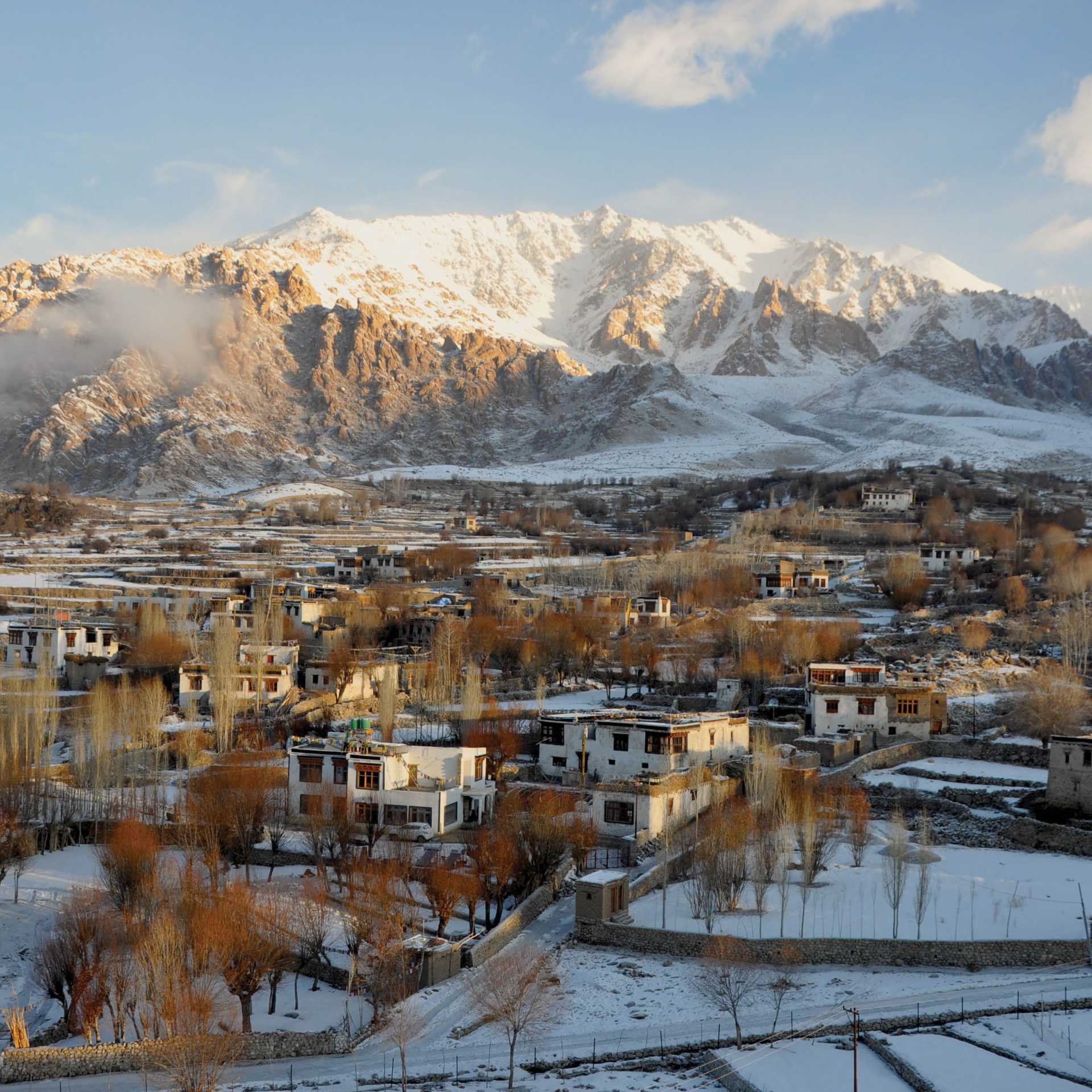
Where Winter Footsteps Leave No Trace By Sidonie Morel Arriving in Leh when the air feels newly sharpened The first breath at altitude The airport doors open onto a cold that does not rush you, but it does set terms. In the first minutes, you notice how quickly moisture leaves the mouth. A sentence feels longer. The inside of your nose stings. In Leh in January, even the simplest actions—hoisting a bag, crossing a small patch of ice near the taxi stand—ask for a fraction more attention than they would elsewhere. On the drive into town, the usual distractions are subdued: fewer honking spirals, fewer clusters of motorcycles, fewer quick detours. The road surface changes from bare tarmac to sections dusted with grit and snow, then back again where sunlight holds. The driver keeps his eyes on the shaded bends, where thin ice can persist long after the day has warmed. There is no drama in how he does it. It looks like routine, which is the first practical lesson of Walking Ladakh in Winter: skill is often quiet. In the guesthouse room, heat arrives as a small, managed thing. A bukhari warms the nearest air first, leaving the corners cooler. You learn where to place your hands. You learn what dries overnight and what does not. A woollen cap becomes an indoor item, not an outdoor accessory. A bottle left near a window turns sluggish, the water thickening into something that pours slowly. None of this feels like hardship in itself; it feels like a set of adjustments that locals have already made, and that a visitor must make without complaint. Streets half-asleep, mountains fully awake In the morning, Leh moves at a different tempo. Metal shutters lift later. The first footsteps are not many, and each one sounds distinct on compacted snow. You can hear a broom scraping outside a shop, the rhythm steady, clearing a narrow path that will not stay clear for long. The sun hits a wall and warms it, and a few minutes later the warmth has travelled into the air just above the stones. People stand briefly in those warm patches, not lingering, simply taking what is offered. Winter makes the town’s surfaces legible: the grain of old brick, the worn edges of steps, the tiny channels where meltwater ran and froze again. A stray dog lies in a strip of sunlight that is almost too precise to be accidental. A woman carries a small bundle of firewood on her back, her boots finding grip without any visible hurry. A boy kicks at a lump of ice until it breaks into cleaner pieces. In a season where everything is counted—water, fuel, daylight—wastefulness looks out of place. A room warmed by a bukhari, a world narrowed to essentials At the end of a walking day, the smallest domestic objects start to matter. A thermos with a reliable lid. A pair of socks that dry to the last seam. A scarf that does not hold too much damp. The cold reveals which things are well made and which are merely decorative. It also reveals your own habits: how often you reach for a phone, how quickly you decide you are tired, how easily you forget to drink when water is not instantly available. In the evenings, you begin to notice the sound of heat: wood shifting, a faint hiss when a kettle begins to work, the soft click of a stove door closing. The air smells of smoke and tea. Outside, the temperature drops cleanly. Inside, the radius of comfort is small but sufficient. You can live within it. Many people do. Snow as a language, not a postcard The different whites: powder, crust, glare Snow in Ladakh is not one thing. A fresh fall looks soft from a distance, but in town it becomes quickly mixed with dust, grit, and footsteps. On the outskirts, where the wind sweeps it, the surface can turn to a firm crust that cracks under weight. In sunny sections, it compacts and shines, a glare that makes you squint even under sunglasses. In shaded sections, it stays dull and hard, with a texture like old sugar. A route that looks simple from a rooftop becomes complex once you are on it. It is here that the great winter narratives from elsewhere become useful—not as stories to imitate, but as a reminder of what matters. The polar travellers wrote about surface as information. On Ladakhi snow, you read the same way: where a boot sinks, where it holds, where yesterday’s melt has refrozen into a thin sheet. A short walk in the wrong shoes can become a lesson you feel for days. Sound in winter: the loudest thing is often your own breathing When the air is cold and dry, sound changes. The crunch of snow becomes sharper. A step on gravel carries farther. A jacket’s fabric makes a small rasp when you lift an arm. A prayer flag line snaps in the wind with a sound like cloth being shaken out. Often, the loudest regular sound is your own breath: inhalation, exhalation, and the slight pause you learn to allow at altitude so you do not turn each climb into a struggle. In the quieter parts of Leh—near old walls, near poplar trees, near courtyards where footprints are few—you can hear household work: water being poured into a bucket, a ladle tapping the rim, a door closed carefully to keep heat in. Those sounds are not scenic details. They are evidence of the effort behind ordinary life in winter. When visibility shrinks, time expands There are days when a light snowfall blurs edges. The mountains retreat into a pale background. A familiar lane looks slightly unfamiliar when its landmarks—colourful signs, stacked stones, the exact shape of a puddle—are softened. You walk slower, not from romance, but from prudence. The world contracts. Small decisions take longer: which side of the street has better grip, whether that shaded patch is safe, whether you should turn back because the light is fading earlier than expected. In these moments, the sense of time changes without requiring any explanation. It is simply how winter travel works. The hour stretches because every metre contains more information. You are not thinking about meaning; you are watching your feet and the line of the path ahead. The mood arrives on its own. Walking days: small distances, full-bodied hours The sun window In summer, Ladakh invites long days. In winter, the day is still long enough to live well, but it is divided more strictly by light. The morning begins cold even in a warm room. Outside, shaded alleys hold last night’s freeze. You wait for the sun to reach the street you plan to take, and that waiting does not feel like laziness; it feels like local sense. Walking Ladakh in Winter means building a day around the sun window: the hours when the surface is most reliable, when the air is warmed just enough to keep fingers functional, when the glare is still manageable. In Leh, you can move between neighbourhoods and know that the difference between sunlight and shade is not merely visual. It affects traction, temperature, and how quickly you tire. Shops understand this. So do drivers, schoolchildren, and the men who clear snow from steps with metal shovels. Hands first, then feet Cold teaches an order of priorities. Before you think about distance, you think about hands. Can you manage laces, buckles, zips, a bottle cap? Can you remove a glove for ten seconds without losing sensation? When you are outside all day, these are not trivial questions. The “practical” details are not separate from the day; they are the day’s structure. At a small tea stall, the heat of a glass arrives first on the palms. The sweetness of tea—often with milk, sometimes with salt—lands on the tongue and makes the mouth feel less dry. A packet of biscuits crumbles in a predictable way. People stand close enough to the kettle to share heat without speaking. If you have walked in European winters, you recognise the same micro-routines, but the dryness here adds a different edge: lips crack faster, skin tightens, thirst hides behind cold. The rhythm of stopping without calling it stopping In winter, pauses are folded into movement. You stop to adjust a scarf before you feel uncomfortable. You stop because a narrow lane has a slick patch and you want to watch someone else cross it first. You stop because a dog is asleep in the only clear line of sunshine and you step around without waking it. These stops are small, but they keep the day intact. There is also the stop that comes from caution: the moment you look at a shaded slope and decide it is not worth it today. The best winter travellers, in any landscape, do not treat turning back as failure. In Ladakh, you see this attitude everywhere, not in speeches but in behaviour. A shopkeeper will close early when the cold sharpens. A family will postpone a visit because a road is glazed. A guide will choose a safer line because the river ice has shifted overnight. The restraint is ordinary. That is what makes it convincing. The river that becomes a road in Zanskar Ice that sings and ice that warns In Zanskar, the idea of a “road” becomes literal in winter when sections of river freeze into a passable surface. People speak of it without romance. It is a route, and like any route it depends on conditions. In some sections the ice is thick and opaque, with a matte surface that takes a boot well. In other sections it is thin, or layered, or newly formed after a cold night, and it answers weight with a sound that is not reassuring. Those who know the river read it with the same seriousness that sailors read weather. They look at colour, at cracks, at the way the water moves under a transparent sheet. They listen. A crisp, high sound can mean one thing; a dull sound can mean another. Sometimes there is water on top, a shallow film that wetens the boot and then freezes at the edge of the sole. Sometimes there are loose stones and snow-covered ledges where the river is not safe to follow and you must climb briefly, then descend again. If it doesn’t sound right, we step off. We don’t argue with ice. Cliffs, shade, and the long blue hours Walking beneath cliffs in winte
source https://lifeontheplanetladakh.com/blog/ladakh-winter-walking/


Comments
Post a Comment