10 Lakes of Ladakh: Salt Silence and the Lines That Hold Water
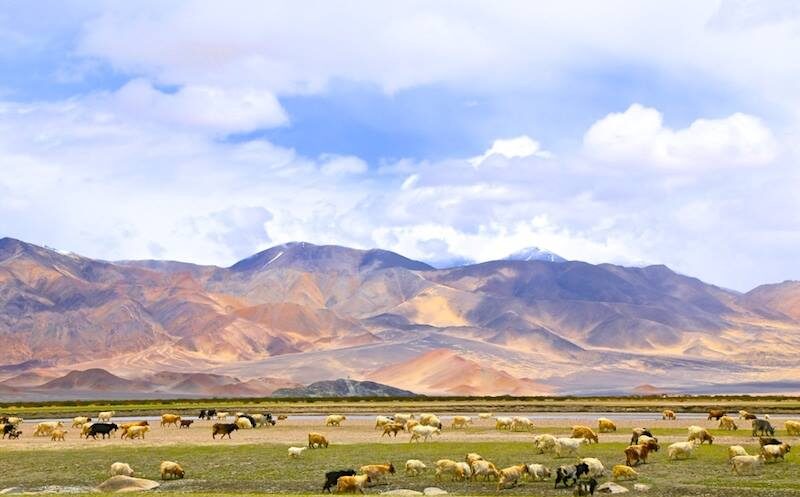
Where Ladakh Keeps Its Water: Salt, Wind, and a Few Quiet Rules By Sidonie Morel Salt first, then the breath The body notices altitude before the mind finds a view In Ladakh, water is never simply “there.” It sits at height, it waits in basins of stone, it gathers under a sky that offers little softness. Even before a lake appears, the body begins to register the conditions that will shape it: the dryness that settles in the throat, the powder-fine dust that clings to seams and shoelaces, the way a metal bottle warms quickly in the sun and cools quickly in shade. People arrive with cameras and conversations; the plateau receives them with a kind of spare arithmetic—altitude, wind, distance, light. The approach to most lakes is a lesson in surfaces. Road gravel rattles under tyres; slate and sand trade places in the cuttings; prayer flags, when they appear, are less decoration than weather report—showing direction, speed, impatience. The air does not smell lush. It smells of sun-warmed rock, of dry grass near a stream, of diesel at the edge of a settlement, of cooking smoke that disperses almost instantly. When a lake finally comes into view, it does so without flourish: a plane of colour laid into a pale bowl, an interruption in a landscape that often looks unfinished until you learn how to read it. For European readers used to water as background—rivers through towns, damp mornings, green banks—high-altitude lakes can feel oddly deliberate. They appear as if placed. They are held by lines: the line of a shoreline crusted with salt, the line of a road permission that must be obtained, the line of a village boundary, the line of a protected wetland where birds are not decoration but residents. Those lines are not always visible, yet they organise everything: where you can stop, where you can camp, where you must keep distance, how you should move, what you must carry out again. Why lakes in Ladakh feel “held” rather than simply “seen” Some of the world’s most photographed lakes are also the most regulated, not because they are fragile in a sentimental way, but because they sit inside overlapping realities: wildlife corridors, grazing ground, pilgrimage routes, military roads, and borders that shift in conversation even when the mountains do not. A lake in Ladakh is rarely a single story. It is a wetland where migratory birds feed, a salt basin that records drought and wind, a mirror used by travellers to measure the sky, a source of drinking water for herders, a destination that can be both sanctuary and stage. This is why the language of “10 lakes” can mislead if it suggests a checklist. These waters do not want to be collected. They reward attention more than accumulation. You notice how the colour changes with a thin cloud passing; how the shore makes a faint crunch when you shift your weight; how the wind pushes small waves to one corner as if the lake has a preferred direction. You notice the practical details too: the moment a driver turns the engine off because idling at altitude is wasteful; the way a thermos cap slips from cold fingers; the sharp brightness that makes you squint even when the temperature feels mild. The best way to travel between Ladakh’s lakes is to accept that you are not moving through attractions, but through conditions—salt, altitude, wind, permission, water scarcity, and the simple fact that roads here are built with effort. The lakes are part of that effort, not separate from it. Pangong Tso — blue that behaves like a mood Color shifts, wind shifts: the same shore, a different hour Pangong Tso is often introduced as a colour: blue, turquoise, sometimes a hard steel under late cloud. Yet what stays with you is not the adjective but the way the surface keeps changing its agreement with the sky. In early light, it can appear almost flat, the water pressed down by cold. Later, when wind arrives from the open plateau, the lake becomes textured, each ripple catching glare, turning the surface into scattered fragments. A photograph freezes one version; the body remembers that there were many. The shore itself is a lesson in material. Pebbles give way to sand, then to wider stones. You find lines of dried foam, a fine white seam where water once sat. If you crouch, you see tiny flecks of salt or mineral residue along the edge. There is no gentle fringe of reeds like a European lake; the margins feel exposed, the water meeting rock without compromise. When people walk down to the shore, you can hear it: the crunch of small stones, the squeak of sand under soles, the brief laughter that rises and then vanishes in wind. Pangong is also a lake you often reach with a crowd. That changes the soundscape—doors closing, engines starting, drones whining, vendors calling. And yet the lake is large enough to absorb human noise without returning it. If you step away from the busiest point, you can still find the plain quiet: a place where you hear mostly wind and the soft slap of waves against stones. In those pockets of stillness, the lake feels less like a landmark and more like a measure of scale. You notice how quickly the light hardens, how shadows under stones look almost black, how the air tastes faintly metallic when the wind picks up dust. A serene surface with a hard edge: the lake near a contested line There is no honest way to write Pangong Tso without acknowledging that it sits near a border whose tension has shaped recent headlines and roadside realities. That presence is not theatrical; it appears in small cues: a checkpoint, a reminder about permits, a road widened with strategic purpose, a convoy passing with the briskness of routine. For some travellers, this is unsettling; for others, it becomes background. For locals, it is simply part of the geography of living and working here. This context changes the ethics of looking. You are not only a visitor in a landscape; you are a visitor in a lived space where access is negotiated. The lake’s stillness does not erase those negotiations—it sits beside them. If you travel here, practical respect is the first form of elegance: carry your identification, follow guidance, do not wander into restricted areas, do not treat a sensitive road as a theatre. Even small acts matter: not flying drones where they are discouraged; not leaving litter that will not decay quickly in cold; not demanding “the best spot” as if you have paid for a private shore. On a long afternoon, Pangong’s most telling detail may be the simplest: the way the wind lifts dust from the road and carries it across the water’s edge, a thin veil over the stones. It is a reminder that the lake is not a separate world; it shares its air with everything around it—roads, people, politics, birds, and the slow, unglamorous work of maintaining presence in a high place. Chagar Tso — the overlooked pause on the way to somewhere else A small high-altitude oasis that appears, then disappears behind speed Chagar Tso is not a lake most travellers can name. That, in its favour, is part of the experience. It tends to appear as a quiet interruption along routes that are otherwise focused on reaching a more famous destination. You are in a vehicle, you are watching the road and the sky, and then a sheet of water arrives on one side—smaller, calmer, almost shy compared to the scale of the plateau. If you blink, you can miss it. If you stop, you realise how many lakes in Ladakh function like this: not as a “place” but as a pause that changes the whole rhythm of the drive. The difference, when you step out, is immediate. The car falls silent. The ears start to notice the thinness of air. The wind has more room to move here than in valleys; it is often direct, with little buffering. The lake, even when small, gathers light in a way that makes nearby stone look paler. There may be no obvious infrastructure—no line of stalls, no crowded photo spot—only water, gravel, and the occasional trace of tyre marks where others briefly stopped before moving on. Chagar Tso is where you learn the pleasure of unclaimed water. Without the pressure of an iconic photograph, you notice subtler things: the way the shore is arranged into bands of texture, from coarse stones at the edge to finer sediment further in; the way small waves collect in one corner, suggesting the wind’s habit; the way a bird’s silhouette briefly cuts across the surface and then is gone. In a travel column, this is valuable: it allows the reader to sense Ladakh’s lakes not only as famous names, but as a repeating element of the landscape—quiet, functional, and often unannounced. When the best view is the one you almost miss There is a temptation in Ladakh to hurry—distances look manageable on a map, days are short, permits and plans compress the schedule. But the plateau has its own pacing. Roads can be interrupted by weather or repairs. A simple stop can become the moment you remember most clearly. Chagar Tso encourages this without preaching. It offers a lake that does not demand a story; it gives you space to notice your own travel habits. One practical suggestion, slipped into the rhythm of travel: keep your warm layer and water accessible even on short stops. Wind at altitude can cut quickly, and thirst is easy to ignore until it becomes a headache. A short, respectful pause—engine off, litter checked, footsteps kept light—can be enough. You leave with nothing more than the memory of a small lake and the sound of stones underfoot, and that can be precisely what the larger itinerary needs. Stat Tso & Lang Tso — twin mirrors, two different answers Two lakes under one sky: reflection as a kind of argument Stat Tso and Lang Tso are often spoken of together, as twins—paired waters on the plateau. “Twin lakes” can sound like a tourism phrase, but here the pairing is genuinely instructive. Two surfaces, close in region, can still behave differently under the same sky. One may catch light with a sharper glare; the
source https://lifeontheplanetladakh.com/blog/10-lakes-of-ladakh/


Comments
Post a Comment