Between Passes and Prayer Stones: A Road Essay from Khalsi to Kargil
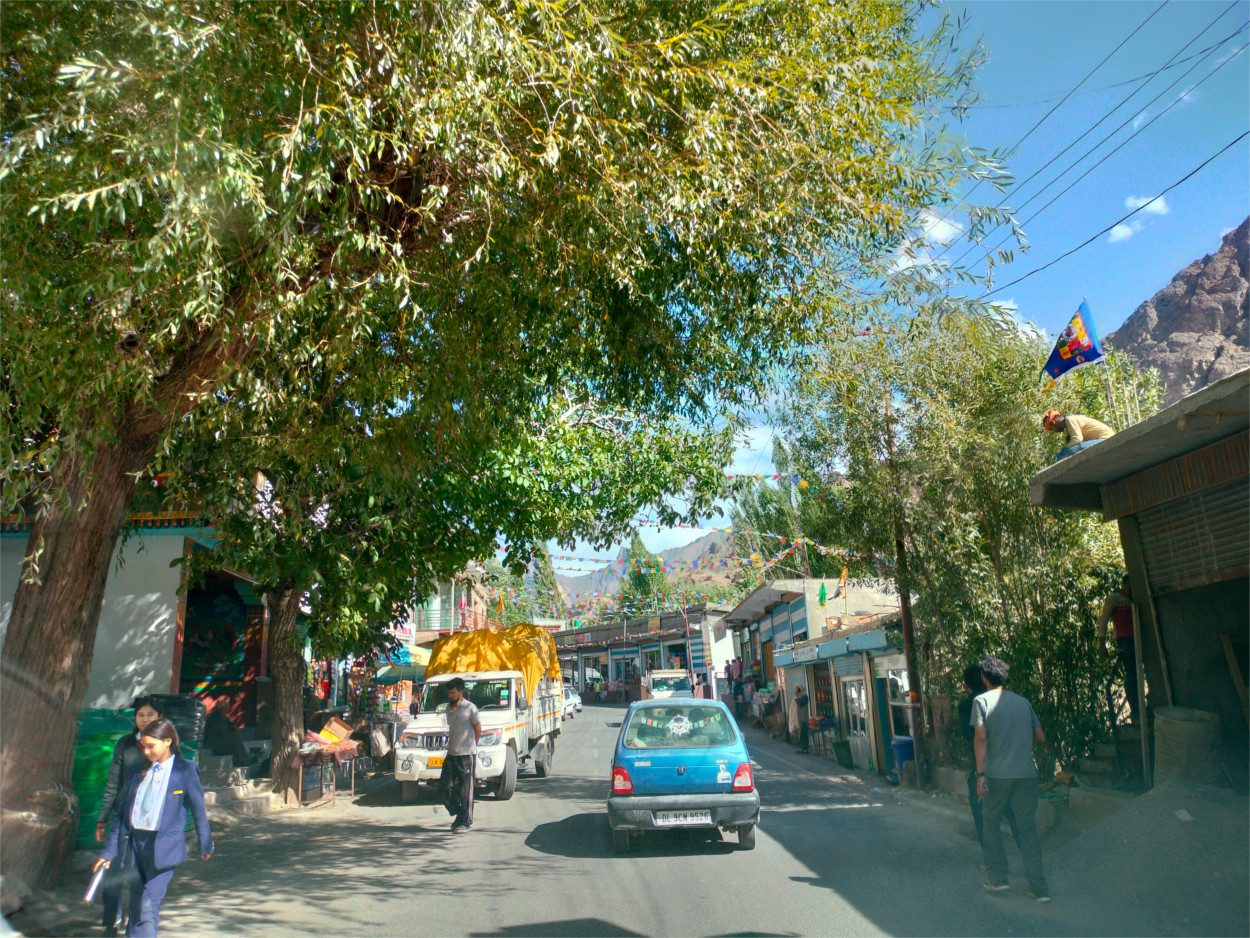
A Road of Small Markets, High Passes, and Carved Stone By Sidonie Morel The first thing you notice on the road from Khalsi to Kargil is how quickly the day becomes a series of tasks: finding tea before the chill settles into your fingers, choosing where to stop without blocking the traffic line, learning the rhythm of honks around blind curves, watching for trucks that drift wide on a turn as if the mountain itself were pushing them. This is not a road for speeches. It is a road for details. Between Passes and Prayer Stones is a good title, but it is also an accurate description of the Srinagar–Leh highway’s Kargil side, where altitude and devotion appear not as ideas but as objects you pass: a braided line of prayer flags tied to a pole, a stone wall repaired with fresh mud, a whitewashed chorten that has caught a season of dust, a carved figure in a cliff face that makes traffic slow down without needing a sign. This stretch from Khalsi to Kargil can be done in a long day if you start early and you are not trying to collect the whole landscape. Most travellers treat it as transit—Kargil as a stopover, Lamayuru as a photograph. But the road has its own geography of attention. It teaches you to look at the working edges: the roadside dhaba where the cook’s hands are blackened with soot; the small shop selling biscuits that have travelled as far as you have; the pass where someone has left a stone under a cairn and moved on without applause. Khalsi: Morning Noise, Metal Shutters, and the First Taste of the Road The market as a small weather system Khalsi wakes in layers. Before the shops are fully open, there is already movement: a man turning a key in a metal shutter that complains as it rises; a woman carrying a sack of onions that bumps against her knee with each step; a boy on a bicycle wobbling under the weight of two plastic jerrycans. The air near the Indus is often softer than what you will meet later—less brittle, less dry—and the smell of the market carries on it: tea leaves, diesel, damp burlap, the faint sweet-sour note of fruit that has been stored a little too long. It is not a “bazaar” in the cinematic sense. It is practical and small, with a few stalls that sell what the road demands: thermos flasks, biscuits, cigarettes, phone recharges, packets of noodles, cheap gloves, and bright plastic that promises to solve problems the mountains will not allow you to forget. The best information comes from the smallest talk. A shopkeeper will tell you, without drama, if the pass ahead has wind or if roadwork is slowing traffic near Lamayuru. Drivers will mention the state of the asphalt not as a complaint but as a calculation—time, fuel, daylight. If you are travelling in a private vehicle, this is where the day can be set gently. A quick cup of chai, a few minutes to buy water, a glance at the sky. It is also where you can notice a human scale before the road takes you into wider emptiness. A bus unloads passengers with bags that look too light for the distance they have travelled. A mechanic wipes his hands on a rag that is more dust than cloth. Someone opens a packet of sweets and shares it without ceremony. The road begins here not with a dramatic gate but with a mundane generosity: people doing what they do every morning, knowing that the passes are waiting and that the day will not pause for anyone who is late. Lamayuru: Moonland, Monastery Walls, and a Silence That Isn’t Empty Dust like flour; cliffs like broken pottery Beyond Khalsi, the green along the river thins. Trees become smaller, then rarer; the land opens into slopes where the soil seems to have been sifted. The “Moonland” name appears on itineraries and roadside signs, but the terrain does not need a metaphor to be understood. It looks like erosion made visible: pale ridges, sharp folds, and a powdery surface that moves when the wind touches it. When a truck passes, dust lifts and hangs for a moment, softening the edges of everything, as if the landscape has briefly changed its mind about being seen. Lamayuru arrives as both place and punctuation. There is a settlement, there are guesthouses and a few shops, but the monastery sits above in a way that changes how you hold your body: you look up, you slow down, you lower your voice without being told. The walls are not precious. They are thick, weathered, familiar with seasons. The flags are faded. The stone steps show the abrasion of years of shoes. Here, religion is not a performance; it is part of the architecture, like drainage channels and retaining walls. If you stop, you notice practical things first. The air is cooler in the shade. Water is carried in containers that are already scuffed. A dog sleeps where the sun warms a patch of ground. Visitors take photos, then move on. What lingers is not grandeur but the quiet logistics of an inhabited high place: a monk crossing a courtyard with a bundle of something wrapped in cloth; a child waiting with an expression of boredom that feels universal; a shop selling biscuits and prayer beads in the same glass case. Lamayuru is also a reminder that this road is used. It is not a scenic corridor built for travellers. It is a route of supply and return—food, fuel, school bags, spare parts, sacks of flour. Between Passes and Prayer Stones can sound like a romantic promise, but at Lamayuru you see the everyday truth behind it: prayer stones exist beside tyre tracks, and both are part of the same day. Fotu La: The Pass Where Breath Turns Practical Thin air, sharp sun, and the body’s quiet arithmetic The climb to Fotu La is steady rather than dramatic. The road works up through bare slopes, sometimes with patches of snow lingering in shadow if the season is early, sometimes with gravel pushed aside by bulldozers if maintenance is underway. You feel altitude most clearly not as a sensation to be admired but as a small change in behaviour: you drink water more often; you stand up more slowly when you get out of the car; you become slightly less interested in talking. At the top, prayer flags and cairns mark the place in a way that is both ceremonial and practical. They tell you: this is the high point; this is where people stop; this is where wind is strong enough to tear cloth into ribbons. There is often a brief traffic jam of photographs—people stepping into the frame, stepping out, wrapping scarves tighter, checking phones for a signal that appears and disappears. Trucks idle, a low vibration under the whole scene. What makes Fotu La memorable is how quickly it returns you to the road. The view is wide, yes, but it is also instructive. You can see lines of ascent and descent, the way the highway threads through the terrain without ever pretending it belongs there. The pass is not a climax; it is a hinge. You can smell cold stone and warm engine, the faint tang of exhaust, and sometimes, on a lucky day, the clean smell of air that has been scraped of moisture. For travellers coming from lower elevations, this is also where acclimatisation becomes real. It is common sense to spend time in Leh to adjust before going higher into Changthang or remote valleys, but even on the Kargil side, passes remind you that the body has limits. A driver will often offer a simple instruction—walk slowly, don’t run, drink water—not as advice but as a routine, the way you might tell someone to fasten their seatbelt. The mountain does not punish; it simply does not negotiate. Between Passes: Small Settlements, Long Shadows, and the Road’s Private Vocabulary Roadside dhabas: steam, salt, and the warmth that arrives too fast After Fotu La, the highway gives you a series of small, matter-of-fact scenes. Roadside dhabas appear at intervals, sometimes just a tin-roofed structure with benches and a stove. Inside, the air is thick with the smell of frying oil and boiled tea. The cups are often metal, warm enough to hold with both hands. There are biscuits in plastic jars, and sometimes a plate of boiled eggs. The menu is short—dal, rice, noodles, omelettes—and the food arrives quickly because it is designed to keep drivers moving rather than to impress anyone. These stops do something important for the narrative of the road: they return you to scale. In a landscape that can feel immense and indifferent, a dhaba is a small enclosed world, held together by heat and routine. The cook’s hands move with practiced speed; someone wipes a table with a cloth that is already stained; a driver leans back and closes his eyes for two minutes, not sleeping but resetting. If there is a radio, it plays low. If there is silence, it is filled by spoons against metal and the hiss of a kettle. Outside again, the road speaks in its own vocabulary. You learn to read piles of gravel as signals of upcoming work. You notice where the asphalt has been patched, where water has cut a groove, where rockfall has left fresh scars on a slope. You begin to recognise the sound of different vehicles: the heavy growl of trucks labouring uphill, the higher pitch of a small car accelerating to pass, the brief sharp brake of someone surprised by a blind bend. For European readers used to motorways that separate you from the landscape, this road can feel intimate. There are no long barriers, no thick margins. You travel close to the terrain. You watch people walk along the shoulder with sacks and bundles. You pass small bridges where the water below is a thin ribbon, but the stones around it show that in another season it can become a force. Practical information lives in these observations. Weather changes quickly; daylight matters; stops are fewer than they look on a map. The road does not ask you to be brave. It asks you to be attentive. Bodh Kharbu: A Soft Fold in the Valley Monastery calm against the restless traffic line Bodh Kharbu feels like a crease in the day. There is a monastery presence here—white walls, a quiet authority—and the valley around it has a gentler rhythm t
source https://lifeontheplanetladakh.com/blog/khalsi-to-kargil-road/


Comments
Post a Comment