Nubra Valley vs Pangong Lake: Two Very Different Ways to Meet Ladakh
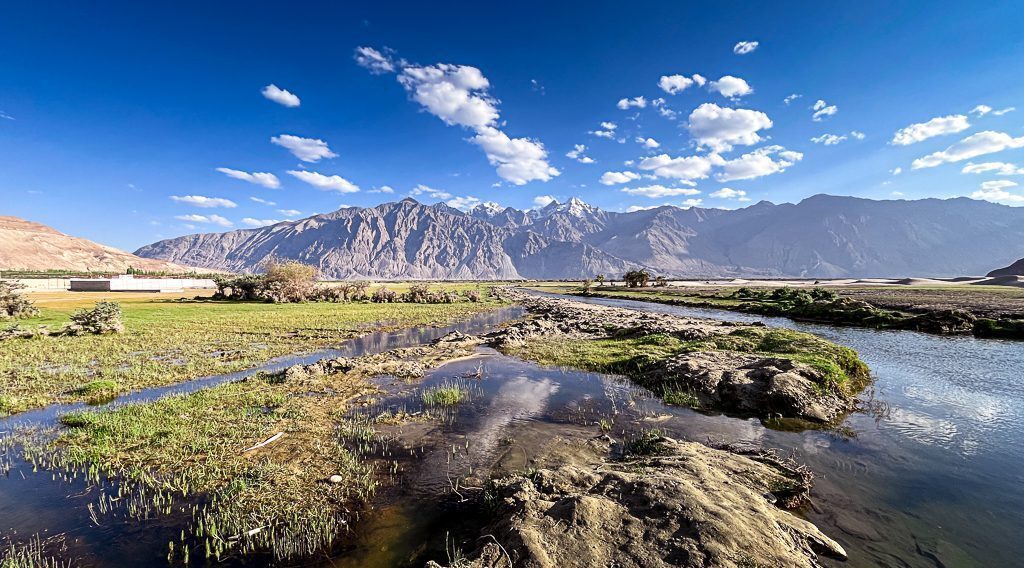
Ladakh has a way of turning a simple road trip into a question of values. Do you want a landscape that feels open, inhabited, and quietly human? Or do you want a place so visually striking that it seems to have been edited by the wind, sun, and altitude itself? In Ladakh, that choice often becomes Nubra Valley versus Pangong Lake. Both are icons. Both belong to the same high-altitude world of thin air, sharp light, and long distances. Yet they offer very different kinds of experience. Pangong is the image many travelers carry in their minds before they arrive in Ladakh: a vast blue lake, bare mountains, and a horizon that seems to float. Nubra, by contrast, is a valley of villages, dunes, monasteries, orchards, and river life. If Pangong is Ladakh as spectacle, Nubra is Ladakh as daily rhythm. Nubra Valley: The Land Between Contrasts Nubra Valley lies north of the main Leh basin, beyond the high passes that make every journey feel earned. The route itself is part of the story. Crossing Khardung La has long been one of the symbolic transitions in Ladakh travel, not because the pass is merely high, but because it marks a shift in mood. On one side is Leh and its compact, stony order. On the other, the valley opens wider, softer, and more varied. Nubra is often remembered for its sand dunes and double-humped camels, but reducing it to that image would miss the point. The valley is shaped by the Shyok and Nubra rivers, with settlements that have grown around water, fields, and trade routes. That is why it feels lived in. Apricot trees, willow groves, barley fields, and compact villages give it a human scale that many high-altitude destinations lose. In spring and summer, the valley can appear almost unexpectedly fertile, especially after the austerity of the road leading in. Discussions of “simple living” in Ladakh fit Nubra especially well. Life here is not an aesthetic performance. It is practical, seasonal, and tied to the land. Homes are built for cold, dry winters and intense sun. Water matters. Shade matters. Distances matter. In such a place, even a cup of tea or a courtyard conversation carries a sense of use and purpose. Travelers who stay a little longer often notice that the valley’s beauty comes not only from scenery, but from the way people have learned to inhabit a difficult environment without fighting it unnecessarily. Nubra also offers cultural depth. Monasteries such as Diskit are not merely stops on a map; they are part of the valley’s spiritual geography. The giant Maitreya statue above the Shyok valley is visible from far away, but the monastery below it remains more compelling for its quiet discipline. Across Nubra, village life, Buddhist practice, and borderland history sit side by side. This is not a place that can be understood in one photograph. Pangong Lake: The Drama of Stillness Pangong Lake belongs to a different register of experience. Reaching it involves crossing another high route from the Leh side, usually through Chang La, and the journey builds anticipation. Once the lake appears, the landscape seems to simplify into line and color: water, stone, sky. That is part of Pangong’s power. It strips away distraction. The lake is famous for its shifting shades of blue, but what many visitors remember most is not color alone. It is scale. Pangong stretches across a great sweep of high-altitude terrain, with much of the lake lying in Tibet and a portion in Indian Ladakh. The result is a feeling of remoteness that is almost physical. Standing there, one does not feel surrounded by scenery so much as placed inside a vast silence. Unlike Nubra, Pangong offers less of the human landscape. There are fewer villages, fewer fields, fewer signs of routine life. That can be a strength, especially for travelers seeking austerity and visual purity. The lake does not ask to be interpreted. It asks to be observed. Dawn and dusk are particularly memorable, when the water darkens, the mountains sharpen, and the shoreline seems to hold its breath. Yet Pangong’s beauty comes with a caution. It is not a place to approach as if it were only a backdrop for photographs. At this altitude, weather changes quickly, temperatures can drop sharply, and the environment is fragile. A responsible visit means moving lightly, respecting local facilities, and understanding that the lake’s appeal is inseparable from the delicacy of the ecosystem around it. Which One Feels More Like Ladakh? The honest answer is that both do, but in different ways. Pangong expresses Ladakh’s vastness, severity, and visual precision. Nubra reveals Ladakh’s continuity, where people have adapted to river valleys, orchards, monasteries, and caravan history. If you want to feel how small a human being can be in the face of altitude and open space, Pangong is unforgettable. If you want to understand how people actually live in Ladakh, Nubra speaks more clearly. This distinction matters because many travelers arrive in Ladakh chasing images and leave with memories of interactions. A lake can inspire wonder in a single glance, but a valley invites a slower kind of attention. In Nubra, you notice irrigation channels, farm walls, kitchen gardens, and the way evening light settles over settlement after settlement. In Pangong, you notice weather, silence, and the changing tone of the water. One is a place of movement and habit. The other is a place of elemental presence. If time is limited, travelers often ask which one to prioritize. The answer depends on what kind of journey they want. Pangong is ideal for those seeking an iconic landscape and a concentrated visual experience. Nubra is better for those who want variety, cultural texture, and a stronger sense of Ladakhi life beyond the postcard. If possible, the best answer is not either-or. Ladakh becomes more complete when the contrast itself is experienced. The Ethics of Seeing Ladakh There is another reason to compare Nubra Valley and Pangong Lake carefully. Ladakh is no longer remote in the old sense of the word. Roads are better than they once were, accommodation has expanded, and more visitors arrive each year. That brings opportunity, but also pressure. Water use, waste management, and the strain on local infrastructure are real concerns, especially in places where the environment already works at the edge of scarcity. Simple living in Ladakh is not a romantic slogan. It is a set of practical habits rooted in necessity. The region teaches restraint: carry less, waste less, speak less loudly, and observe more. Whether in Nubra or at Pangong, the most respectful traveler is the one who understands that beauty here is not infinite in the way a city view can seem infinite. It is maintained by fragile systems and by local communities who live with the consequences of every season. That is why the better question may not be which destination is prettier, but which kind of attention each destination asks of us. Pangong asks for stillness and humility before scale. Nubra asks for curiosity about life under difficult conditions. Both can deepen one’s understanding of Ladakh, provided the visit is approached with care. Choosing With the Right Expectations Nubra Valley rewards travelers who enjoy layered landscapes and a slower pace. It is well suited to those who want to see villages, monasteries, river crossings, and agricultural life in one region. Pangong suits those who want a powerful, distilled encounter with high-altitude wilderness. It is less about variety and more about impact. For the traveler interested in simple living, Nubra may leave the stronger impression. There is something moving about a landscape where life continues through irrigation channels, stone walls, and local routines that feel older than modern tourism. Pangong, though less inhabited, teaches a different lesson: that not every meaningful place needs to be busy or furnished with comfort. Sometimes the most memorable experience is a lake at altitude, a cold wind, and enough silence to hear your own thoughts. Ladakh does not need to be turned into a competition between its famous places. Nubra Valley and Pangong Lake belong to the same larger truth: this is a region where endurance, beauty, and restraint are inseparable. To see Ladakh well is to appreciate both the inhabited valley and the austere lake, both the ordinary and the sublime. Together, they reveal why travel here still feels like an education rather than a consumption of scenery. Author Bio: Junichiro Honjo is the founder of LIFE on the PLANET LADAKH and an advocate of sustainable tourism, with a focus on respectful travel, local culture, and the fragile high-altitude environment of Ladakh. The post Nubra Valley vs Pangong Lake: Two Very Different Ways to Meet Ladakh appeared first on LIFE on the PLANET LADAKH.
source https://lifeontheplanetladakh.com/blog/nubra-valley-vs-pangong-lake-two-very-different-ways-to-meet-ladakh/


Comments
Post a Comment